Virtual Medical Administrative Assistant vs In-House


A virtual medical administrative assistant costs far less than an in-house hire and starts faster, but an in-house hire is still the better choice when the work has to happen in person. This side-by-side compares cost, start time, and coverage, then names the situations where hiring in-house is the right call.
The in-house numbers come from government wage data. The virtual numbers come from My Medical VA's starting rate. You can check the math yourself.
KEY TAKEAWAYS
- A virtual medical administrative assistant costs a fraction of an in-house hire once benefits are counted.
- Start time is the widest gap: a 48-hour match and 3 to 5 day onboarding, versus weeks of recruiting.
- In-house still wins for in-person tasks, work that needs a licensed professional, and practices that cannot support remote access.
- Many practices land on a hybrid: an in-house front desk and a virtual assistant for the back office.
Cost: Wages Are Only Part of the In-House Number
Start with the wage. The median wage for medical secretaries and administrative assistants was $45,930 a year in May 2025, according to the Bureau of Labor Statistics.
Wages are not the full bill. BLS employer cost data shows wages and salaries made up 70.0 percent of employer compensation costs for private industry workers overall in June 2026, and benefits made up the other 30.0 percent.
Applying that split to the median wage and one in-house hire costs roughly $65,600 a year in total compensation ($45,930 divided by 0.70). For full-time workers alone, BLS puts the wage share at 68.5 percent, which lifts the estimate to about $67,050.
Treat $65,600 as the conservative figure. It is a national-average estimate, so use it as a benchmark for your own quote.
It also leaves things out: recruiting time, training, equipment and software seats, office space, and the cost of replacing someone who leaves.
On the virtual side, the starting rate is $9/hour. A full-time schedule of 2,080 hours (40 hours for 52 weeks) comes to $18,720 a year. Your rate depends on the role and experience level you need, so read that figure as the low end of the range.
Start Time: Weeks of Hiring vs a 48-Hour Match
Hiring an administrative employee is slow before it is expensive. According to Mitratech's summary of HR.com's 2025 survey, most nonexempt roles took 30 to 60 days to fill, and about a quarter took more than 90.
That is time to fill. Orientation, system access, and training come after.
With a virtual assistant from My Medical VA, you review a matched candidate within 48 hours of your consultation. Onboarding takes 3 to 5 days.
A fast start still needs a ramp. The first weeks need written checklists and daily review. A handoff plan that begins with repeatable tasks gets accuracy up sooner.
Coverage: Who Is There When the Work Piles Up
Coverage is where the comparison gets less one-sided.
An in-house employee works your location and your hours. When they are out sick, on leave, or gone for good, the work stalls until someone covers it or you hire again.
A virtual assistant is one person. The difference shows when the match is wrong: My Medical VA replaces the placement at no additional cost, so a poor fit does not restart your recruiting clock.
Ask any provider how absences are covered before you commit. It is a fair question for either option.
A virtual assistant works your practice hours from a remote location, inside the systems you approve. They cannot cover anything that needs a body in the building.
When an In-House Hire Is Still the Better Choice
Be honest about the work itself. Hire in-house when:
- The job is mostly in person. Greeting patients, collecting payments at the window, and handling paper mail and faxes need someone on site.
- You need one person to bridge the front desk and the exam room. That combines clinical duties with administrative work, which makes it a medical assistant role.
- Your systems cannot support remote access. If staff cannot reach your EMR and payer portals from outside the building, remote help has nothing to work in.
- Nobody can direct remote staff. A virtual assistant needs written checklists and a daily point of contact, especially in the first two weeks.
- The workload is only a few hours a week. A full-time role of any kind is more than you need.
Outsourcing still works for the right tasks. The task list should decide the hire.
When a Virtual Medical Administrative Assistant Is the Better Choice
Choose the virtual option when:
- The work is on a screen and follows rules. Eligibility checks, prior authorization, claim follow-up, and chart prep all qualify.
- A vacancy is costing you revenue. You cannot wait weeks to fill it.
- You want a predictable monthly cost. No benefits, payroll taxes, or equipment to manage.
- Patient volume moves. You can scale hours up or down with no long-term commitment.
- You want compliance settled first. HIPAA training is complete and a signed BAA is in place before anyone touches patient data.
These tasks sit inside the medical admin role: administrative and billing work only. Clinical decisions, final code selection, and anything needing a licensed professional's judgment stay with your team either way.
The Hybrid Model Many Practices Choose
Many practices split the work. A common split keeps an in-house person at the front desk for everything in person and gives the back office to a virtual assistant.
The in-house employee handles check-in, payments, and patients in the lobby. The assistant handles insurance verification, authorizations, claim follow-up, and documentation from a screen. Each does the work they are best placed to do.
That split also lightens the in-house role, which no longer carries a backlog of screen-based tasks.
How to Run the Comparison for Your Practice
You do not need a spreadsheet. Four steps are enough.
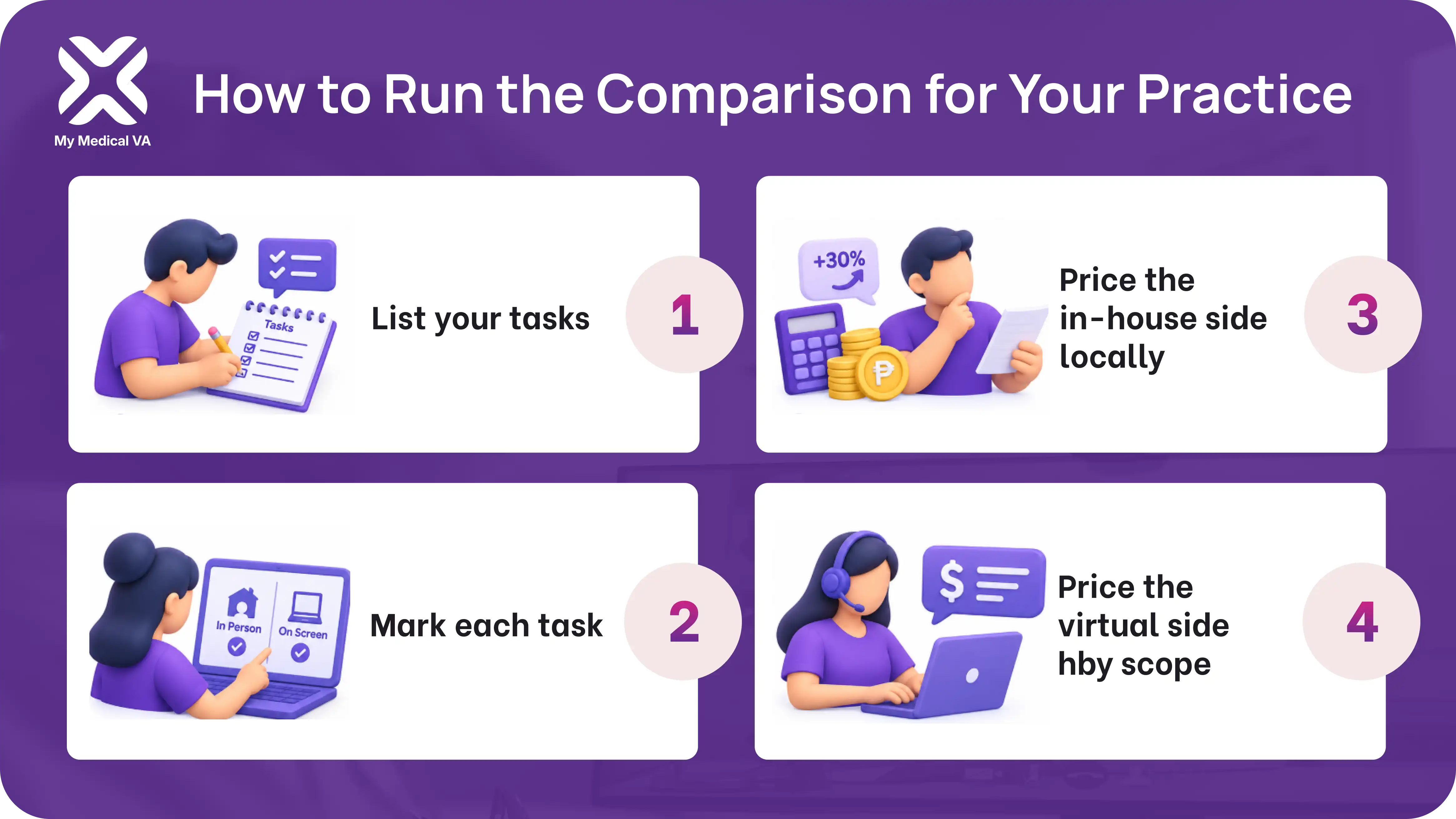
List your tasks
Write down what the role would actually do each week.
Mark each task
In person, or on a screen?
Price the in-house side locally
Use your market's wage for the role, then add roughly 30 percent for benefits and payroll costs.
Price the virtual side by scope
Rates depend on role and experience, so ask for a quote based on your task list.
If most tasks land in the "on a screen" column, the virtual option deserves a serious look. If most land in the "in person" column, hire in-house.
Virtual Medical Administrative Assistant vs In-House Virtual Assistant
Six factors, side by side.
How My Medical VA Fits
My Medical VA places a dedicated Medical Admin Assistant matched to your EMR and specialty. Every assistant is HIPAA-trained, and a signed BAA is in place before day one. Placements start at $9/hour with no long-term contract.

For the full scope of the role, see admin services. For a wider look at what drives rates, read the cost guide.
Ready to Price Out a Virtual Medical Administrative Assistant?
Put your own task list next to the table above. If most of the work is on a screen and follows rules, a virtual medical administrative assistant will likely cover it for far less than an in-house hire. If most of it is in person, hire in-house and use the virtual option for the back office.
The fastest way to run this comparison for your practice is a short conversation about your task list, your EMR, and what an in-house hire would cost where you are. Book a Consultation Now!
Your Guide To Common Questions & Solutions
Is a virtual assistant cheaper than an in-house hire?
Yes.
My Medical VA placements start at $9/hour, which is $18,720 a year at 2,080 full-time hours. By comparison, BLS data puts the median wage for the role at $45,930 before benefits, which add roughly 30 percent of total compensation in private industry. Your rate depends on role and experience.
How fast can a virtual assistant start?
You review a matched candidate within 48 hours of your consultation, and onboarding takes 3 to 5 days. In-house hiring takes longer: most nonexempt roles take 30 to 60 days to fill, before onboarding begins.
When should I hire in-house instead?
Hire in-house when the work is mostly in person, when you need one person bridging the front desk and clinical duties, when your systems cannot support remote access, or when the workload is only a few hours a week.
Can a virtual assistant work inside my EMR?
Yes.
Your assistant is matched to your EMR and payer portals before placement and works under role-based access, so permissions cover only the systems each task needs.
Does a virtual assistant replace my front desk?
No.
The role covers administrative and billing work done on a screen. Greeting patients, taking payments at the window, and other in-person tasks stay with on-site staff, which is why many practices use a hybrid.
Is a virtual assistant HIPAA-trained?
Yes.
Every My Medical VA assistant completes HIPAA training before placement and works under a signed BAA, role-based access controls, and encrypted communication.