Medical Administrative VA: Delegate These First


A medical administrative VA should take over tasks that pass three tests: they repeat on a schedule, follow written rules, and touch revenue directly. Hand those off in week one. Add the judgment-heavy work in month one, and keep clinical and coding decisions in-house.
Most practices delegate in the wrong order, starting with whatever annoys them most. This guide gives you a repeatable way to sequence the handoff.
KEY TAKEAWAYS
- A medical administrative VA delivers the fastest payoff on tasks that are repeatable, rule-based, and revenue-linked.
- Week one covers insurance verification, appointment confirmations, intake follow-up, and claim status checks.
- Month one is when a medical administrative VA adds prior authorization, claim submission, denial follow-up, and provider-directed EMR documentation.
- Coding decisions, appeal strategy, and clinical judgment stay with your licensed team.
Why the Order You Delegate to a Medical Administrative VA Matters
Hand a new assistant your most complex task first, and the first month goes to correcting errors. Hand them only trivial tasks, and your numbers never move.
The BLS notes that medical administrative staff need to be familiar with medical terminology, codes, and records, and may train for several months to learn industry-specific practices. A new assistant is no different.
Familiarity builds with exposure. The sequence you choose decides how quickly accuracy arrives.
The fix is to sort tasks before you hand them over, not after something goes wrong.
The Three-Part Test for Any Task
Score every candidate task on three questions. Each takes seconds.
Is It Repeatable?
The task happens on a fixed cadence with the same steps each time. Eligibility checks before every appointment qualify. A one-off payer dispute does not.
Repeatable work builds accuracy fast because the assistant practices the same motion daily.
Is It Rule-Based?
A new hire could follow it from a written checklist without asking for judgment calls. If you can write the steps as "if X, do Y," it passes.
If the answer depends on clinical context or years of instinct, it fails.
Is It Revenue-Linked?
A delay or error costs money directly: a denied claim, a missed authorization, an empty appointment slot, an aging balance.
Revenue-linked tasks show a measurable result within weeks. That makes the handoff easy to justify and easy to evaluate.
How to Score
- Three yes answers: delegate in week one.
- Two yes answers: delegate in month one, after the routine is stable.
- One or none: keep in-house or revisit later.
- Any task that needs a licensed professional's judgment stays in-house, whatever its score.
Scoring Example
Take appointment reminders. They happen daily, follow a script, and protect the schedule from no-shows. Three yes answers, so they start in week one.
Now take final code selection. It repeats and affects revenue, but it is only partly rule-based and it needs a credentialed professional's judgment. The gate applies, so it stays in-house.
Run your own task list through the same filter and the order writes itself.
Week One: Tasks a Medical Administrative VA Takes Over First
Week-one tasks share a profile. They score three of three, they need only portal and EMR access, and mistakes surface quickly because results are visible within a day or two.
Insurance Verification
Eligibility and benefits checks before each visit are the cleanest first handoff. The steps are identical for every patient, the payer portal gives a clear answer, and an error shows up fast as a denial or a surprise bill.
Insurance verification is where most practices see the first measurable change.
Appointment Confirmations and Reminders
Confirmation calls and texts follow a script and a calendar. They need no clinical judgment, and they protect the schedule directly, since an unconfirmed slot is a likely no-show.
Intake Follow-Up
Chasing unsigned consent forms, missing insurance cards, and incomplete demographics is repetitive and rule-driven.
Handing off patient intake follow-up means patients arrive complete. Your front desk checks them in instead of catching up.
Claim Status Checks
Checking submitted claims against payer portals and logging the result is read-only work. It carries little risk, produces a clear list of what needs attention, and ties directly to cash flow.
Each of these needs a one-page checklist and role-based access to the portals and EMR modules it touches. Nothing more. That keeps day one simple and the onboarding window short.
Month One: Tasks to Add Once the Routine Is Stable
These tasks score two of three or carry higher stakes. They need payer-specific knowledge or write access, so add them after two to three weeks of reviewed, accurate week-one work.
Prior Authorization
Submission rules differ by payer and by service, and follow-up has to continue until a decision arrives. It is strongly revenue-linked, but payer exceptions make it only partly rule-based.
Add prior authorization once the assistant knows your payer mix.
Claim Submission and Charge Review
Entering charges and scrubbing claims before they go out requires coding awareness and write access to your billing system.
Start review-only, where the assistant flags issues for your biller, then move to submission. Claims submission stays tied to your biller's final sign-off.
Denial Follow-Up
Categorizing denials, gathering documentation, and preparing appeals is repeatable and revenue-critical. Appeal reasoning varies by case, so the assistant prepares and your billing lead decides.
Provider-Directed EMR Documentation
Entering notes, orders, and chart updates at a provider's direction saves real provider time. It demands accurate terminology and consistent formatting, so start with a narrow template.
See how EMR documentation support works for the full scope.
What to Keep In-House
A medical administrative virtual assistant handles administrative and billing work. These stay with your licensed team:
- Clinical decisions and anything requiring a provider's judgment
- Final code selection and coding determinations
- Appeal strategy and write-off decisions
- Financial policy and exception approvals
- Patient clinical questions and triage
Keeping these in-house is what lets you trust the handoff.
Your Handoff Plan at a Glance
Eight common tasks, scored against the three-part test and sequenced by start date.
A Simple 30-Day Rollout
Sequence matters, and so does review. A medical administrative virtual assistant ramps faster with a cadence like this:
- Before day one: write a one-page checklist for each week-one task and set up role-based access.
- Days 1 to 5: the assistant works the week-one tasks. Review every output.
- Week 2: spot-check a daily sample and track errors by task.
- Weeks 3 and 4: add month-one tasks one at a time, review-only first.
Adjust the pace to your accuracy results, not the calendar.
Three Handoff Mistakes to Avoid
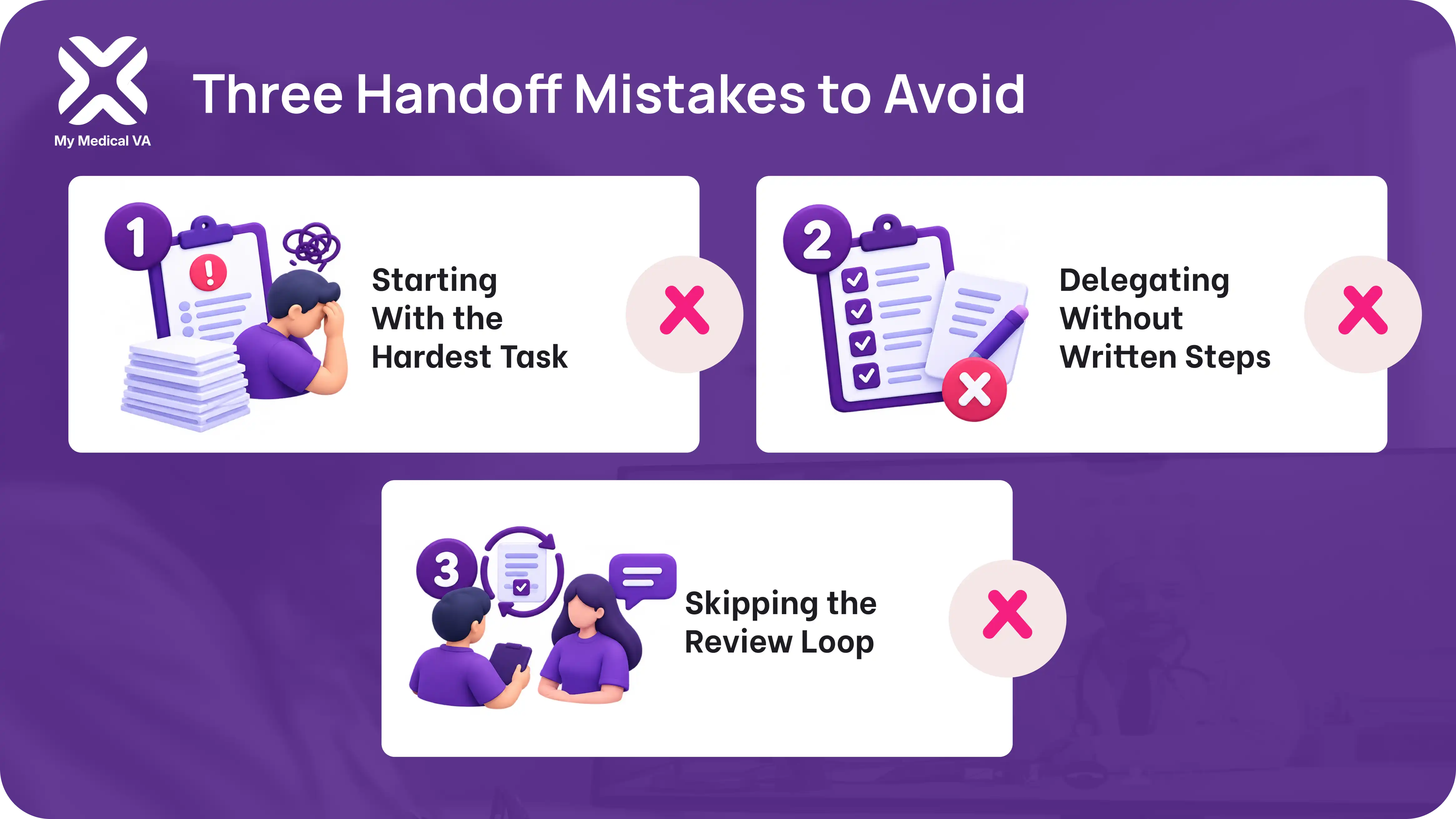
Starting With the Hardest Task
It feels efficient to offload the biggest pain first. It is also where a new assistant is most likely to struggle, and early errors cost trust.
Delegating Without Written Steps
An assistant cannot follow a process that lives in someone's head. A one-page checklist per task removes most early mistakes.
Skipping the Review Loop
Delegation includes a short daily review in the first two weeks.
How My Medical VA Supports This Plan
My Medical VA places a dedicated Medical Admin Assistant matched to your EMR and specialty within 48 hours, with onboarding completing in 3 to 5 days. Every assistant is HIPAA-trained, and a signed BAA is in place before day one.
Placements start at $9/hour with no long-term contract. Your assistant takes the week-one tasks first and adds month-one tasks as you approve them. See the medical admin role for the full scope.

Ready to Hand Off Your First Tasks to a Medical Administrative VA?
Start with the four week-one tasks. Score the rest with the three-part test, and add them as the routine holds. A medical administrative VA delivers the most value when the handoff follows a plan, not a mood.
The fastest way to build your own sequence is a short conversation about your EMR, your payer mix, and where your team loses the most time. Book a Consultation Now!
Your Guide To Common Questions & Solutions
What does a medical administrative VA do?
A medical administrative VA handles repeatable, rule-based admin and billing work for a practice: insurance verification, appointment confirmations, intake follow-up, claim status checks, prior authorization, and provider-directed EMR documentation. The role is administrative only, with no clinical function.
What should I delegate to a medical administrative VA first?
Start with tasks that are repeatable, rule-based, and revenue-linked: insurance verification, appointment confirmations, intake follow-up, and claim status checks. Add prior authorization, claim submission, denial follow-up, and EMR documentation in month one.
How much does a medical administrative VA cost?
My Medical VA placements start at $9/hour with HIPAA training, the BAA, and account management included, and no long-term contract.
Which systems can a medical administrative VA work in?
Your assistant is matched to your EMR and payer portals before placement and works under role-based access, so permissions cover only the systems each task needs.
Can a medical administrative VA handle clinical tasks?
No.
Clinical decisions, final code selection, and appeal strategy stay with your licensed team. The assistant prepares and tracks administrative work under your direction.
Is a medical administrative VA HIPAA-trained?
Yes.
Every My Medical VA assistant completes annual HIPAA training before placement and works under a signed BAA, role-based access controls, and encrypted communication.