Physician Virtual Assistant: Tasks, Cost, and How to Hire


A physician virtual assistant is a trained remote staff member who takes administrative and billing work off a physician's desk: charting support, scheduling, inbox routing, prior authorization, and billing follow-up. It is not a clinical role. My Medical VA places HIPAA-trained assistants starting at $9/hour, matched within 48 hours.
This guide covers what a virtual assistant for doctors handles day to day, what it costs, how it compares with hiring in-house, and how to run the first 30 days.
KEY TAKEAWAYS
- A physician virtual assistant handles administrative and billing work only, never clinical decisions, diagnosis, or patient care.
- In a 2016 time-and-motion study, physicians spent nearly two hours on EHR and desk work for every hour with patients. That is the work an assistant can take on.
- A virtual assistant for doctors starts at $9/hour with HIPAA training, the BAA, and account management included, and no long-term contract.
- Plan the first 30 days with a physician virtual assistant in stages: low-risk tasks first, then authorizations and documentation, with daily review early on.
Why Physician Time Is the Real Cost
Start with how the day is spent. A time-and-motion study of 57 physicians in four specialties, published in Annals of Internal Medicine in 2016, found physicians spent 27.0% of the office day on direct clinical face time and 49.2% on EHR and desk work.
That works out to nearly two hours of EHR and desk work for every hour with patients. Self-reported diaries from part of the group put another one to two hours of that work into personal time each night.
The study is a decade old and covers four specialties, but the pattern is familiar to most practice owners. A physician virtual assistant takes the screen-based part of the load. The clinical judgment stays with you.
What a Physician Virtual Assistant Handles Day to Day
Each row starts with the pain point, then shows what the assistant does about it.
What a Typical Day Looks Like
- Start of day: confirms the day's appointments, checks eligibility for tomorrow's schedule, and clears overnight faxes.
- Midday: submits and follows up on authorizations, routes inbox messages, and tracks referral reports.
- Afternoon: preps charts for the next day and updates the charts you have finished.
- End of day: sends you a short list of anything that needs your decision.
That last list keeps your attention items in one place instead of scattered across the inbox.
What the assistant does not do: clinical decisions, patient triage, diagnosis, prescribing, or final code selection. The role also does not include in-room scribing. Those stay with your licensed team.
Two of these rows have dedicated pages: prior authorization and patient intake. The medical admin page covers the full scope, and family doctors can see how the same work looks in a family medicine practice.
Physician Virtual Assistant Cost and What Is Included
A physician virtual assistant from My Medical VA starts at $9/hour on a flat monthly rate. Placements are full-time and dedicated. Every placement includes:
- Annual HIPAA training, before placement and every year after
- A signed Business Associate Agreement (BAA)
- Criminal background check and identity verification
- EMR matching and verification before you meet the candidate
- A dedicated account manager
- HR and payroll management, handled by My Medical VA
- A replacement guarantee
No benefits, payroll taxes, or office costs are added on top, and there is no long-term contract.
Because the rate is flat, a busy week does not raise the bill. It also does not add hours, so lasting growth in volume is a reason to talk about adding an assistant.
Rates depend on the role and experience level you need. See the pricing page for current options, or read the cost guide for what drives price across staffing models.
One cost sits outside any vendor's rate: your own software. Ask your EMR and payer-portal vendors whether an added user needs a license.
Physician Virtual Assistant vs In-House Hire
Hire in-house when the job is mostly in person, such as greeting patients or collecting payments at the window.
Many practices split the work. An in-house person covers the front desk and everything in person. A virtual assistant covers back-office administration and billing.
How Hiring Works
Signs You Are Ready to Hire
- Charts regularly stay open after hours.
- Authorizations wait on your desk.
- Your front desk is covering admin work that is not at the front desk.
If two of the three sound familiar, the next step is a task list.
The Four Steps
- Book a consultation. Share your tasks, EMR, weekly schedule, and specialty.
- Review your match. A matched candidate is presented within 48 hours. You confirm before any commitment.
- Onboard. HIPAA training is verified, the BAA is signed, and role-based access is set up. Onboarding takes 3 to 5 days.
- Launch. Your assistant starts on the first tasks on your list, under your direction.
Have three things ready: a task list, a list of your systems and payer portals, and your rules for what needs your attention.
Five Checks Before You Commit
- A signed BAA before anyone touches patient data, and HIPAA training completed before placement.
- EMR and payer-portal experience verified against your actual systems.
- A dedicated assistant, not one shared across clients.
- Written answers on what the rate includes and what costs extra.
- A replacement guarantee, in writing.
Your First 30 Days
Staging the work keeps early errors small and trust high.
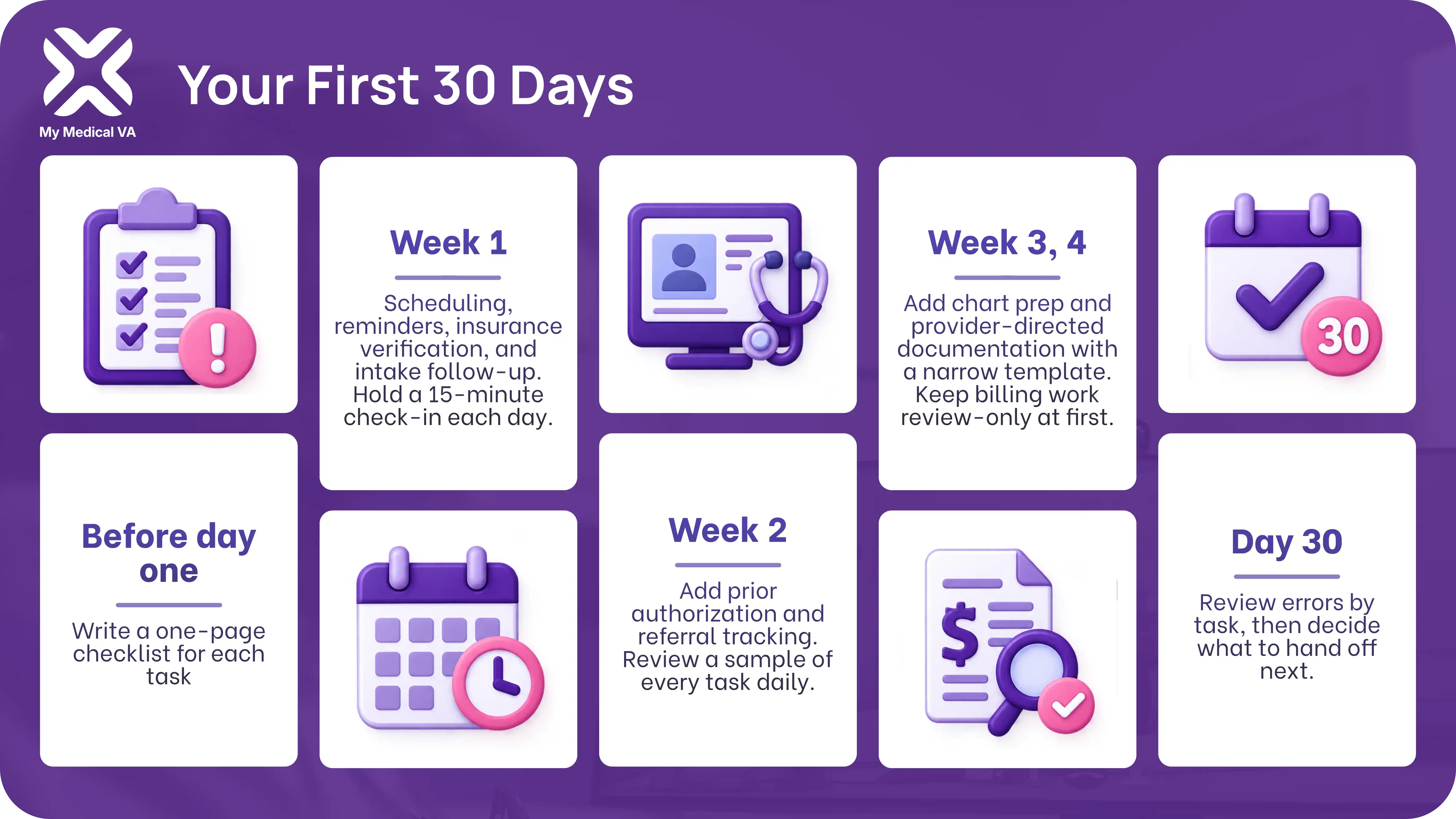
- Before day one: Write a one-page checklist for each task. Write your "needs me" rules too, such as any clinical question, any message that mentions symptoms, and any authorization denial that needs a peer-to-peer review.
- Week 1: Scheduling, reminders, insurance verification, and intake follow-up. Hold a 15-minute check-in each day.
- Week 2: Add prior authorization and referral tracking. Review a sample of every task daily.
- Weeks 3 and 4: Add chart prep and provider-directed documentation with a narrow template. Keep billing work review-only at first.
- Day 30: Review errors by task, then decide what to hand off next.
Track four things so the review has data: how long charts stay open, how long authorizations take to reach a decision, your no-show rate, and how many evenings you still spend charting.
For a task-by-task sequence, see the handoff plan.
Ready to Hand Off Work With a Physician Virtual Assistant?
Start with the tasks that eat your evenings: chart prep, authorizations, and the inbox. A physician virtual assistant works best when the first month has a plan and a daily check-in.

The fastest way to build your first 30 days is a short conversation about your tasks, your EMR, and what you want back on your calendar.
Your Guide To Common Questions & Solutions
What does a physician virtual assistant do?
A physician virtual assistant handles administrative and billing work: chart prep and provider-directed documentation, scheduling and reminders, inbox and fax routing, insurance verification, prior authorization, referral tracking, and billing follow-up. The role is administrative only, with no clinical function.
How much does a physician virtual assistant cost?
My Medical VA placements start at $9/hour on a flat monthly rate, with HIPAA training, the BAA, and account management included, and no long-term contract. Rates depend on the role and experience level. The pricing page shows current options.
Can a virtual assistant for doctors answer patient messages?
It can sort messages and handle routine administrative requests such as appointment questions, forms, and records. Anything clinical is flagged for you or your nurse. The assistant does not triage or give medical advice.
Can a physician virtual assistant work inside my EMR?
Yes.
Your assistant is matched to your EMR and payer portals before placement and works under role-based access, so permissions cover only the systems each task needs.
Is a virtual assistant for doctors HIPAA-trained?
Yes.
Every My Medical VA assistant completes annual HIPAA training before placement and works under a signed BAA, role-based access controls, and encrypted communication.
How fast can I start?
A matched candidate is presented within 48 hours of your consultation, and onboarding takes 3 to 5 days.