Virtual Assistant for Psychiatric Practice: What to Expect

A virtual assistant for psychiatric practice handles the administrative load specific to medication management: prior authorization for psychiatric drugs, refill coordination, session-limit tracking, and the billing codes tied to med management visits. None of it is clinical. All of it is what keeps a psychiatric practice's revenue and scheduling from quietly falling apart.
KEY TAKEAWAYS
- A virtual assistant for psychiatric practice carries an administrative pattern distinct from general mental health, driven by medication management and prior authorization volume.
- Psychiatrists spend roughly 20% of their working hours on administrative tasks, more than the average physician.
- A virtual assistant for a psychiatric practice already understands session-limit tracking and medical management billing codes. A general hire does not.
- The role is administrative and billing only. Prescribing, diagnosis, and treatment decisions stay with your psychiatrist.
Why a Virtual Assistant for a Psychiatric Practice Handles More Than General Admin
Ask a psychiatric practice owner what eats their week, and prior authorization comes up almost immediately.
Psychiatric medications get flagged for review more often than medications in most other specialties. Antipsychotics, stimulants, and certain mood stabilizers routinely require prior authorization before a pharmacy will fill them, and that authorization frequently has to be renewed.
The administrative load this creates is measurable. According to Psychiatric News, a publication of the American Psychiatric Association, psychiatrists spend an average of 10.6 hours per week, about 20.3% of their working hours, on administrative tasks. That is close to three hours more per week than the average physician, who spends 8.7 hours, or 16.6% of working hours, on the same category of work.
Layer onto that a scheduling pattern with a higher no-show rate than most specialties, since the symptoms that bring a patient to a psychiatrist are often the same symptoms that make it hard to show up consistently. Add session-limit tracking, since many behavioral health benefit plans cap visit counts or require reauthorization at set intervals, something a biller unfamiliar with psychiatric benefit structures will miss until a claim gets denied.
A virtual assistant for a psychiatric practice is built around this specific pattern, not a general admin task list borrowed from primary care.
What to Expect a Virtual Assistant for a Psychiatric Practice to Handle
A matched assistant from My Medical VA covers the following, verified against your practice's specific workflows before placement.
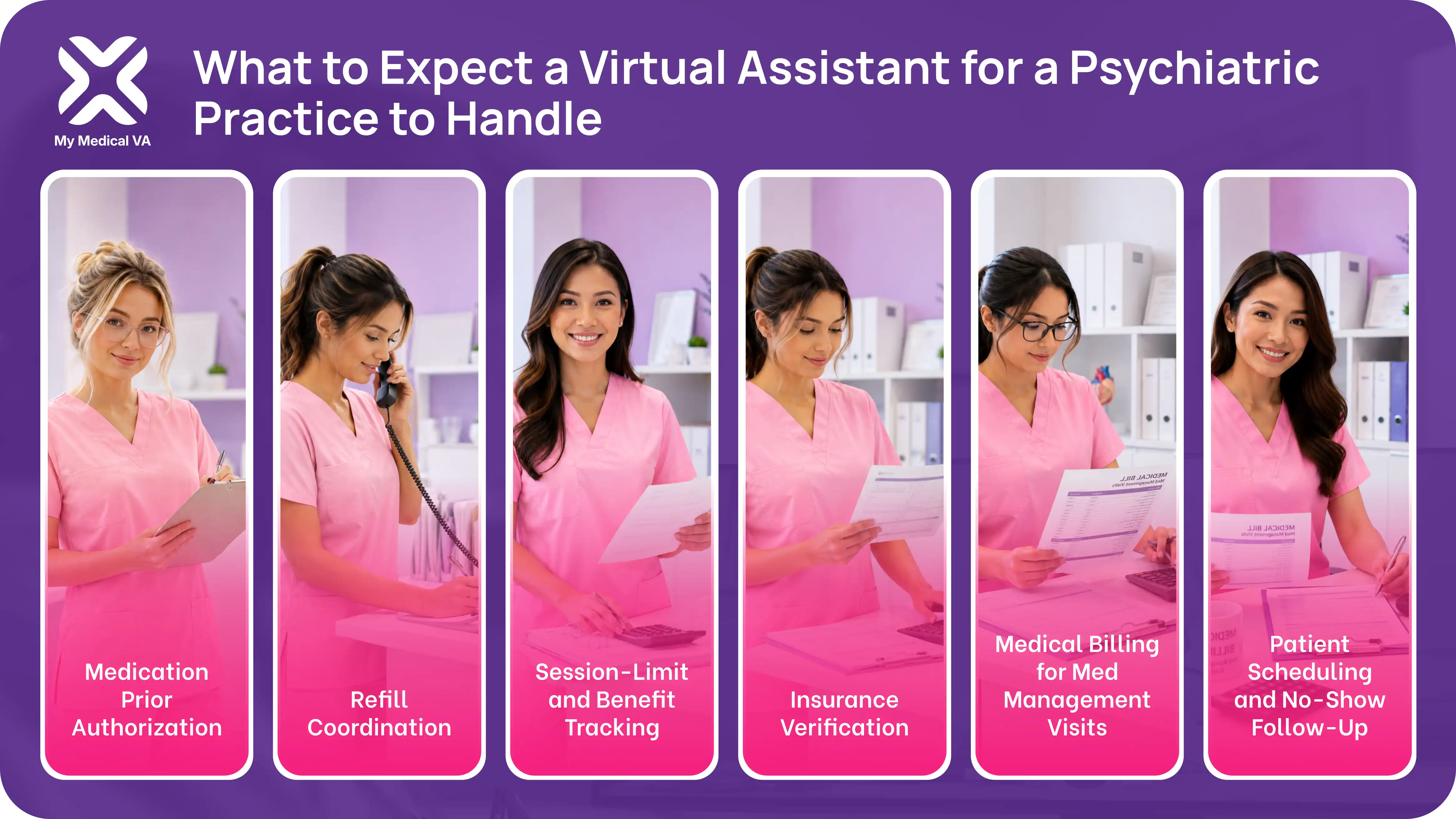
Medication Prior Authorization
Screening upcoming refills and new prescriptions for authorization requirements, submitting complete requests with the documentation each payer needs, and following up until a decision is received. This is the single highest-volume task in most psychiatric practices, and it is the one a general assistant struggles with most without prior psychiatric experience.
Refill Coordination
Managing pharmacy communication for refill requests, confirming prescriptions are current before a patient runs out, and flagging any authorization gap before it becomes a missed dose. A missed psychiatric medication dose is not a minor lapse. It can undo weeks of treatment stability.
Session-Limit and Benefit Tracking
Monitoring visit counts against payer session limits, and flagging when a patient is approaching a cap that will require reauthorization to continue treatment. Practices without this tracking often discover the limit only when a claim is denied, well after the session already happened.
Insurance Verification
Confirming active coverage and behavioral health benefits before each visit, including the session limits and copay structures that differ from general medical benefits. Behavioral health benefits are frequently carved out to a separate administrator, which a general verification process is not built to catch.
Medical Billing for Med Management Visits
Charge entry and claim scrubbing that accounts for psychiatric-specific billing codes, initial evaluation, medication management add-ons, and psychotherapy add-on codes, so claims go out coded correctly the first time. Miscoding a med management visit is one of the most common reasons a psychiatric claim gets denied on first submission.
Patient Scheduling and No-Show Follow-Up
Managing a schedule with a higher cancellation pattern than most specialties, including proactive reminders and rescheduling outreach built around that reality. A schedule designed for a general practice's no-show rate will consistently underperform in a psychiatric setting.
For the full scope of what a matched mental health virtual assistant handles, visit the mental health specialty page.
What the Role Does Not Do
A virtual assistant for a psychiatric practice is administrative and billing support only. Prescribing decisions, diagnosis, treatment planning, and any clinical judgment stay entirely with your psychiatrist. The assistant does not perform scribing during patient encounters and does not have clinical authority of any kind. What they remove is the paperwork standing between your psychiatrist and the next patient, not the practice of psychiatry itself.
What Sets a Matched Assistant Apart From a General Hire
A general virtual assistant can learn medical billing basics quickly. Psychiatric-specific prior authorization patterns take longer, and the cost of that learning curve shows up as denied claims and missed refills, not just slower onboarding.
A matched assistant already knows which psychiatric medications routinely trigger authorization review, how session-limit tracking works across the payers your practice bills, and how med management visit codes differ from a standard office visit. That is the difference between an assistant who needs training before they are useful and one who is useful from week one.
Virtual Assistant for Psychiatric Practice vs. In-House Staff
What to Expect From Setup
Setup follows a predictable path. Share your practice's EMR, payer mix, and the specific prior authorization patterns creating the most friction. Within 48 hours, review a matched, HIPAA-trained candidate with verified psychiatric administrative experience. Onboarding completes in 3 to 5 days, so most psychiatric practices have an assistant working inside their EMR within one week.
Ready to Bring a Virtual Assistant Into Your Psychiatric Practice?
A virtual assistant for psychiatric practice takes on the medication authorization, refill coordination, and billing work that a general hire is not built for. That administrative volume does not go away on its own.

Your Guide To Common Questions & Solutions
What does a virtual assistant for a psychiatric practice do?
A virtual assistant for a psychiatric practice handles medication prior authorization, refill coordination, session-limit tracking, insurance verification, medical billing for med management visits, and patient scheduling. The role is administrative and billing only, with no clinical function.
Why do psychiatric practices need more prior authorization support than other specialties?
Psychiatric medications require prior authorization more frequently than medications in most other specialties, and psychiatrists spend close to three more hours per week on administrative tasks than the average physician. That volume requires dedicated, consistent follow-up to avoid delayed refills and denied claims.
How much does a virtual assistant for a psychiatric practice cost?
My Medical VA places psychiatric practice admin assistants starting at $9/hr on a flat monthly rate, with HIPAA training, the BAA, and account management included, and no long-term contract.
Can a virtual assistant track session limits for behavioral health benefits?
Yes.
Monitoring visit counts against payer-specific session limits and flagging when a patient approaches a cap requiring reauthorization is a core part of the role for psychiatric and mental health practices.
Is a virtual assistant for a psychiatric practice HIPAA-trained?
Every My Medical VA assistant completes annual HIPAA training before placement and works under a signed BAA, role-based access controls, multi-factor authentication, and encrypted communication.
How quickly can a psychiatric practice get matched with an assistant?
Most practices are matched within 48 hours of the initial consultation, with onboarding completing in 3 to 5 days.