Patient Intake Process: How To Reduce No-Shows and Data Errors

The patient intake process is the set of steps a practice uses to register a patient, collect their information, verify insurance, and prepare them for care, from the moment an appointment is booked through check-in. Done well, intake keeps the schedule full, the data clean, and the front desk calm. Done poorly, it feeds two expensive problems that practices feel every month: patients who do not show up, and claims that get denied over preventable data errors.
This guide covers what the patient intake process includes, the seven steps that make it work, why intake quality shows up directly in revenue, and how to fix the parts that most often break.
What Is the Patient Intake Process?
The patient intake process is how a medical practice gathers and verifies everything it needs before a patient is seen: demographics, insurance and eligibility, medical history, consent forms, and payment details. Intake starts when an appointment is scheduled and ends when the patient is checked in and ready for the clinical team.
Intake is administrative work, not clinical work. It does not involve diagnosis or treatment decisions. It is the layer that makes the clinical visit possible by ensuring the right information is captured accurately, the insurance is confirmed, and the required paperwork is complete before the provider walks in.
The 7 Steps of the Patient Intake Process
The patient intake process breaks into seven steps that move a patient from a booked appointment to a ready-for-care check-in. Each step collects or confirms a specific piece of information, and a gap at any step tends to surface later as a no-show, a billing error, or a delay in the waiting room.
- Appointment scheduling — The patient books a visit, and the practice captures the reason for the appointment and basic contact details.
- Pre-registration — Before the visit, the practice collects demographics, insurance information, and medical history so check-in is faster and more accurate.
- Insurance and eligibility verification — Staff confirm the patient's coverage, plan status, copay, and any prior authorization needs ahead of the appointment.
- Forms and consent — The patient completes intake forms, consent documents, and any practice-specific paperwork, ideally before arrival.
- Demographic and history data entry — Staff enter or confirm the patient's information in the electronic health record, checking for errors and mismatches.
- Copay and payment collection — The practice collects copays, outstanding balances, or deposits as required.
- Clinical handoff — The completed, verified record is handed to the clinical team so the provider can begin the visit without administrative gaps.
Why Is the Patient Intake Process Important?
The patient intake process directly affects two numbers every practice tracks: how many claims get paid, and how many patients show up. Intake sits at the front end of the revenue cycle, so an error made during registration or verification does not stay there. It travels downstream into denied claims, rework, and lost time.
Start with denials. According to Change Healthcare's Revenue Cycle Denials Index, nearly half of all claim denials trace to front-end revenue cycle issues, and registration and eligibility problems alone account for close to 27 percent of denials. Around 86 percent of those denials are preventable, which means most of the loss comes from intake steps a practice can tighten.
Experian Health's 2025 State of Claims survey points the same direction: more than a quarter of respondents said at least one in ten denials stems from inaccurate or incomplete information captured at patient intake.
Then there are no-shows. The Medical Group Management Association (MGMA) puts the average practice no-show rate at 5 to 7 percent, though the figure varies widely by specialty and setting, with some outpatient studies reporting much higher.
The cost is what makes it matter: industry analyses cited by MGMA estimate that no-shows and last-minute cancellations can eat around 14 percent of a medical group's daily revenue, with losses near $150,000 per physician per year in some models. A reliable intake process, built on confirmed contact details and a consistent reminder cadence, is one of the few levers your practice fully controls.
Common Patient Intake Problems and How to Fix Them
Most intake problems fall into five recurring categories. The table below maps each problem to its downstream impact and the fix that addresses the root cause.
The pattern across all five is the same: the fix is to move work earlier and add a verification step, rather than collecting and entering everything in a rush at the front desk on the day of the visit.
How Do You Effectively Automate the Patient Intake Process?
While automation handles volume well, it does not handle exceptions well. So to effectively automate the patient intake process, you can assign repeatable tasks (reminders, digital forms, e-signatures, and real-time eligibility checks) to software and have a patient intake specialist responsible for the judgment calls.
Software is weak at the parts that need follow-up and interpretation. When an eligibility check comes back ambiguous, when a patient returns a form with missing fields, when insurance information does not match across records, or when a patient needs a reminder call rather than a text, someone has to act.
That gap between what software flags and what actually gets resolved is where intake breaks down, and it is the gap that most practices underestimate when they buy a tool and expect intake to run itself.
Intake Software vs. In-House Staff vs. a Patient Intake Specialist (Medical VA)
The three common ways to run patient intake are intake software, in-house front-desk staff, and a medical virtual assistant. Most practices use a combination, and the right mix depends on volume, budget, and how many exceptions the team handles each day. The table below compares the three across the factors that matter most.
Software and a virtual assistant are not competitors. Software automates the predictable tasks, and a virtual assistant handles the follow-up, verification, and exceptions that software flags but cannot finish. That combination is usually cheaper and more reliable than adding another in-house hire to absorb intake overflow.
How a Patient Intake Specialist Streamlines Patient Intake
A patient intake specialist streamlines patient intake by owning the administrative follow-up work that keeps the schedule full and the data clean. Also called a medical virtual assistant, they work remotely as part of your team, handling the intake tasks that do not require an on-site presence.
For patient intake, a medical virtual assistant typically handles:
- Pre-registration calls and outreach — Confirming and collecting patient details before the visit so check-in is fast and accurate.
- Insurance and eligibility verification — Checking coverage, copays, and authorization needs ahead of appointments, then following up on anything unclear.
- EHR data entry and verification — Entering patient information accurately and checking it against the source to catch mismatches before they become denials.
- Appointment reminders and confirmations — Running a consistent reminder cadence across text, call, and email to reduce no-shows.
- Form follow-up — Chasing down incomplete or missing forms before the patient arrives.
The work is administrative throughout. A patient intake specialist does not make clinical decisions. By taking the verification and follow-up load off the front desk, a patient intake specialist directly targets the two problems intake exists to prevent: missed appointments and preventable data errors.
Best Practices for a Smooth Patient Intake Process
A smooth patient intake process comes down to doing the work earlier and verifying it twice. The practices below address the root causes behind no-shows and data errors rather than the symptoms.
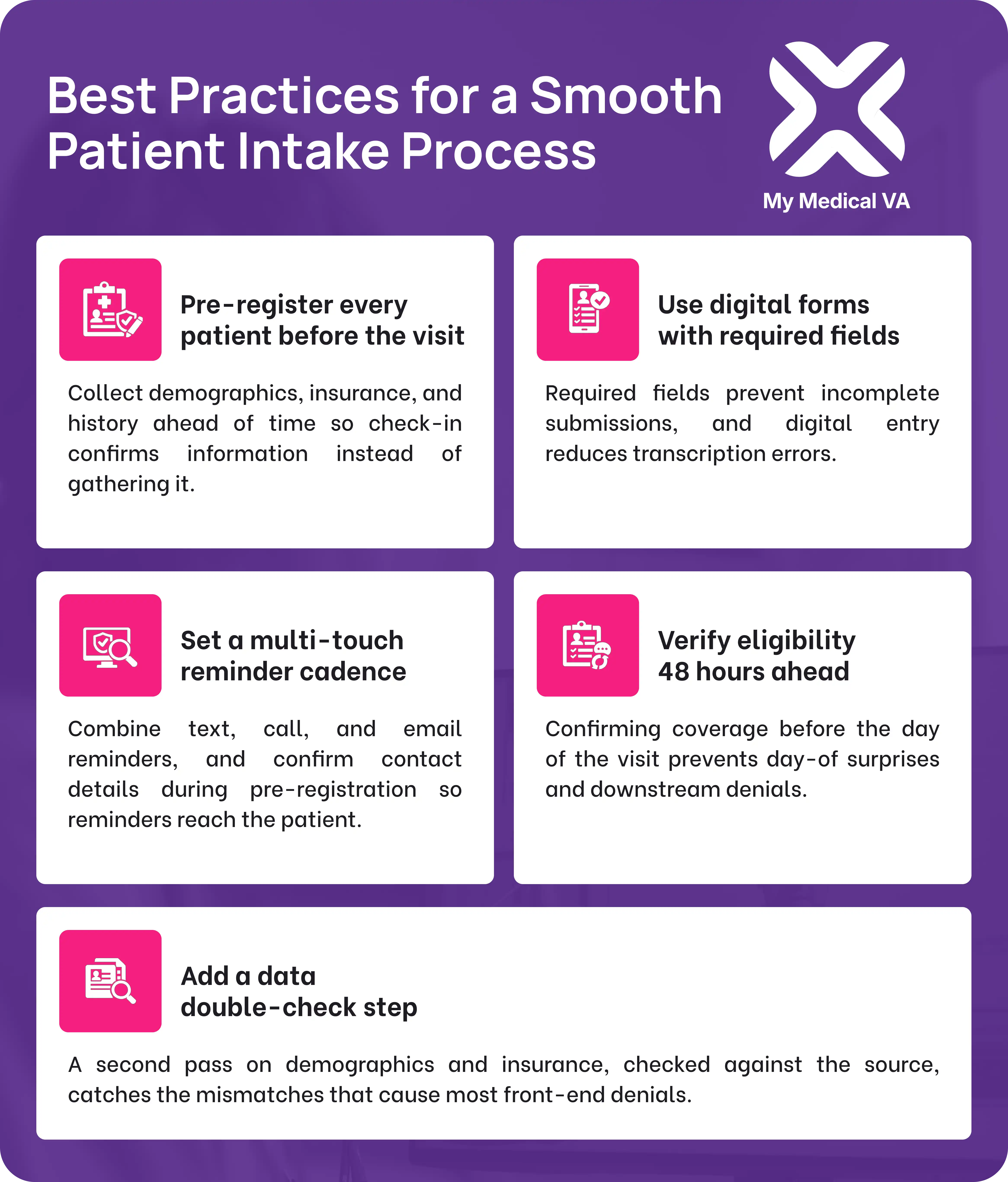
- Pre-register every patient before the visit — Collect demographics, insurance, and history ahead of time so check-in confirms information instead of gathering it.
- Use digital forms with required fields — Required fields prevent incomplete submissions, and digital entry reduces transcription errors.
- Set a multi-touch reminder cadence — Combine text, call, and email reminders, and confirm contact details during pre-registration so reminders reach the patient.
- Verify eligibility 48 hours ahead — Confirming coverage before the day of the visit prevents day-of surprises and downstream denials.
- Add a data double-check step — A second pass on demographics and insurance, checked against the source, catches the mismatches that cause most front-end denials.
Run a Cleaner Intake Process With MyMedicalVA
The patient intake process is one of the few revenue levers a practice fully controls, and most of its failure points are preventable. A trained medical virtual assistant from MyMedicalVA handles the pre-registration, insurance verification, data entry, and reminder work that keeps no-shows and data errors down, without adding office overhead.
Your Guide To Common Questions & Solutions
What is the patient intake process?
The patient intake process is how a medical practice registers a patient and collects and verifies their information before care, including demographics, insurance and eligibility, medical history, consent forms, and payment. Intake starts when an appointment is booked and ends when the patient is checked in and ready to be seen. It is administrative work that prepares the patient for the clinical visit.
Why is the patient intake process important?
The patient intake process is important because intake data determines whether a claim gets paid and whether a patient shows up. Intake is the front end of the revenue cycle, so errors here become denied claims and rework downstream. Industry analyses attribute close to half of all claim denials to front-end issues like registration and eligibility, and most of those denials are preventable at intake.
How can a practice reduce no-shows during intake?
A practice can reduce no-shows by confirming patient contact details during pre-registration and running a consistent, multi-touch reminder cadence across text, call, and email. Shorter lead times between booking and the appointment also help. Reliable reminders depend on accurate contact information, which is why reminder strategy and intake quality are linked.
What causes data errors during patient intake?
Data errors during patient intake usually come from rushed, manual entry at the front desk, demographic or insurance mismatches between the patient's records and the payer's, and incomplete forms collected on the day of the visit. These errors are a leading cause of preventable claim denials. Moving registration to pre-visit and adding a verification step addresses most of them.
Can a virtual assistant handle patient intake?
Yes, a medical virtual assistant can handle the administrative parts of patient intake, including pre-registration, insurance and eligibility verification, EHR data entry, appointment reminders, and form follow-up. A virtual assistant does not make clinical decisions. The role is to take the verification and follow-up workload off the on-site front desk so intake stays accurate and the schedule stays full.