Medical Virtual Assistant Referral Coordination: A Practice Guide

Medical virtual assistant referral coordination is the process of a dedicated remote Medical Admin Assistant managing a referral end to end. It starts the moment a provider decides to refer a patient. It ends only when the specialist report comes back and the loop is closed in the chart.
This replaces ad hoc tracking with a defined process. This guide covers what it involves, where referral leakage happens without a dedicated owner, and how a Medical Admin Assistant handles it.
KEY TAKEAWAYS
- Medical virtual assistant referral coordination closes the loop on every referral, from initiation through specialist confirmation and chart documentation.
- Referral leakage happens quietly, a referral sent but never confirmed, or a specialist report that came back but was never reviewed.
- A dedicated owner with a defined follow-up cadence is what prevents referrals from sitting open for weeks unnoticed.
- The role is administrative only. Referral coordination is typically bundled into a Medical Admin Assistant's broader task scope, not billed as a separate service.
Why Medical Virtual Assistant Referral Coordination Breaks Down Without a Dedicated Owner
Referral coordination touches multiple systems and multiple people: your EMR, the specialist's office, and the patient. When front desk staff handle it reactively, alongside check-in, phones, and walk-ins, referrals get initiated but not consistently tracked to completion.
The result is referral leakage. A referral gets sent but never confirmed. A patient never schedules with the specialist. A specialist report comes back but is never reviewed and closed out in the chart.
None of these show up as an obvious daily problem. They show up months later as gaps in care coordination, and by then they are hard to trace back to a single missed step.
A practice that refers frequently, to cardiology, orthopedics, behavioral health, or any recurring specialist relationship, generates enough referral volume that this needs a dedicated process. It cannot be an occasional task squeezed into a busy day.
What Medical Virtual Assistant Referral Coordination Actually Covers
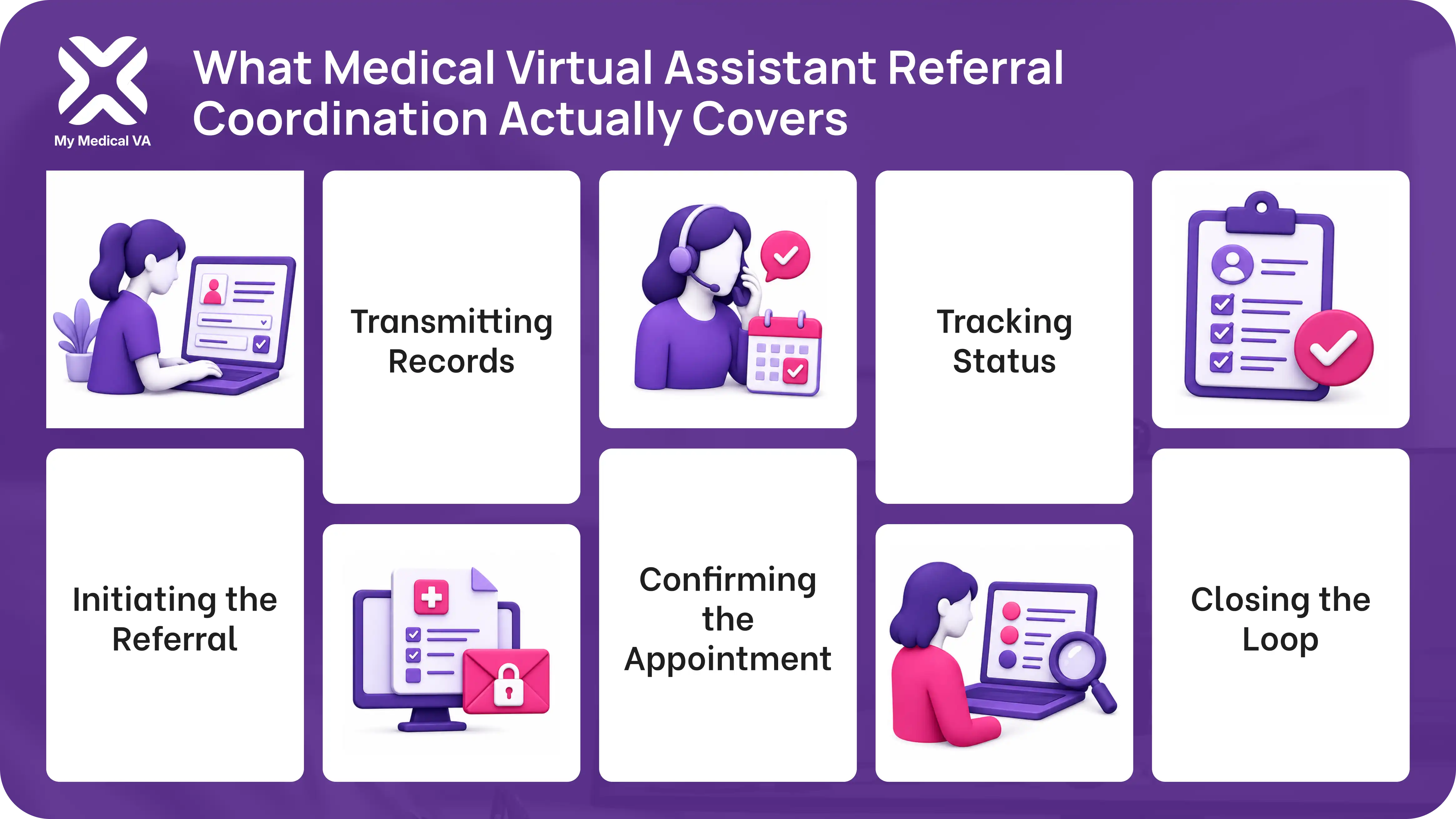
Initiating the Referral
Entering the referral in the EMR with the correct specialist, reason for referral, and supporting clinical documentation. This step sets up everything that follows, an incomplete referral at this stage creates delays the specialist's office cannot resolve on their end.
Transmitting Records
Sending the relevant patient records and referral documentation to the specialist office through secure, HIPAA-compliant channels. Missing documentation here is one of the most common reasons a specialist's office pushes an appointment back or requests a resend.
Confirming the Appointment
Following up with the patient and the specialist office to confirm the appointment was scheduled, not just sent. A referral that was transmitted but never confirmed is functionally the same as a referral that was never sent at all.
Tracking Status
Monitoring open referrals in a referral tracking system and following up when a specialist office has not responded within an expected window. This is the step that gets skipped first when front desk staff are managing referrals reactively, and it is where most leakage accumulates.
Closing the Loop
Documenting completion in the chart once the specialist report is received, so the referring provider has visibility into the outcome without having to ask. Closing the loop is what separates a referral that was completed from one that was simply sent and forgotten.
This is the difference between a referral that was sent and a referral that was completed. The gap between those two things is where most practices lose track.
Front Desk Referral Handling vs. Dedicated Referral Coordination
How a Medical Admin Assistant Handles This Differently
Front desk staff manage referral coordination alongside check-in, phones, and same-day scheduling. Referrals compete for attention with whatever is happening at the counter right now.
A dedicated Medical Admin Assistant owns referral coordination as a defined task. They work a referral tracking system daily, not fit it in between interruptions.
That ownership is what closes the loop consistently. A referral tracked by one person with a defined follow-up cadence does not sit open for weeks without anyone noticing, which is the most common source of referral leakage in a busy practice.
What to Expect When You Add This to a Medical Admin Assistant's Scope
Referral coordination is one task among several a Medical Admin Assistant typically handles, alongside insurance verification, prior authorization, and billing support. Rates start at $1,936/month for a Junior assistant and from $2,288/month for a Senior assistant, flat monthly, with the specific task mix scoped to what your practice needs most.
Most practices are matched with an assistant within 48 hours and onboarded within 3 to 5 days. My Medical VA, a remote healthcare staffing company, places dedicated, HIPAA-trained assistants who handle referral coordination alongside your practice's broader admin workload. For the full scope of the service, see referral coordination.
Ready to Fix Your Medical Virtual Assistant Referral Coordination Process?
A dedicated Medical Admin Assistant closes the loop on every referral instead of letting it drop between check-in and the next phone call. Medical virtual assistant referral coordination turns a task that gets skipped under volume into a defined process someone actually owns.

Your Guide To Common Questions & Solutions
What is medical virtual assistant referral coordination?
It is the process of a dedicated remote assistant managing a patient referral from initiation through specialist confirmation and closed-loop documentation in the chart.
How much does referral coordination support cost?
It is typically included as part of a Medical Admin Assistant's broader task scope, starting at $1,936/month for a Junior assistant and from $2,288/month for a Senior assistant.
Is referral coordination HIPAA-compliant when handled remotely?
Yes.
Referral coordination involves protected health information, so it is handled under HIPAA-compliant workflows, including a signed Business Associate Agreement and encrypted communication.
Can referral coordination be combined with other admin tasks?
Yes.
Most practices pair it with insurance verification, prior authorization, and billing support under the same dedicated assistant.
How fast can a practice get referral coordination support in place?
Most practices are matched within 48 hours and onboarded within 3 to 5 days of a consultation.