Medical VA Hourly vs Monthly Pricing: Which Costs Less?


Medical VA hourly vs monthly pricing comes down to how steady your workload is. Hourly billing costs less when you need only a few hours a week. A flat monthly rate costs less per productive hour when the work is steady and the rate includes training, compliance, and management.
My Medical VA uses a flat monthly rate that starts at $9/hour. The examples below hold the hourly rate constant so you can see what the pricing model itself changes, and every assumption is labeled.
KEY TAKEAWAYS
- Medical VA hourly vs monthly pricing is a question of workload, not rate: hourly wins on small or irregular hours, flat monthly wins on steady, near-full-time work.
- Compare effective hourly cost: total cost including every fee, divided by hours actually worked.
- A flat monthly rate bundles training, compliance, and management. Hourly arrangements vary, so ask what is billed separately.
- My Medical VA charges a flat monthly rate that starts at $9/hour, with HIPAA training, the BAA, and account management included.
Medical VA Hourly vs Monthly Pricing at a Glance
Six factors, side by side.
Hourly billing is a meter. Flat monthly pricing is a defined schedule at a fixed price. Neither is cheaper on its own, so the rest of this post puts numbers on the difference.
Cost Examples by Practice Size and Weekly Hours
Start with the assumptions. Change any of them and the numbers move.
- Rate: $9/hour, My Medical VA's starting rate. Each extra $1/hour adds about $173 a month on a full-time schedule. Your quote depends on the role and experience level.
- Weeks per month: 4.33 (52 weeks divided by 12).
- Schedule: My Medical VA placements are full-time and dedicated, so the flat monthly figure is for 40 hours a week. Adding capacity means adding an assistant.
- Hourly comparison: the same $9/hour, billed only for hours worked, with no extra fees. This isolates the pricing model.
- Practice sizes and weekly hours: illustrative, not benchmarks.
Example 1: Same Rate, Different Hours
At the same rate, the two models meet at full-time hours. Below that, hourly billing costs less, because a full-time placement is priced for the whole schedule.
That is the case for hourly: a light workload does not need a full-time role.
Example 2: What Extra Fees Do to an Hourly Quote
Now add fees. Take a hypothetical hourly vendor at the same $9/hour that charges a $500 setup fee and $300 a month for account management. Run it on a full-time schedule for 12 months.
- Hypothetical hourly vendor: $18,720 in labor, plus $500 setup, plus $3,600 in account fees. Total: $22,820, or $10.97 per hour worked.
- Flat monthly at the starting rate: $18,720, or $9.00 per hour, with training, compliance, and account management included.
The vendor is invented for illustration, and real fees vary. The method is what matters: add every fee, then divide by hours worked.
With those fees, the break-even moves from 40 hours down to about 31 hours a week. Between roughly 20 and 30 hours, the right answer depends on the fees in your quote.
Example 3: What a Higher Rate Does
Rates depend on role and experience. Suppose your quote lands at $11/hour instead of $9, a hypothetical $2 difference. On a full-time schedule that adds about $347 a month, or $4,160 a year.
Compare the all-in number.
What Is Included in Each Model
Flat Monthly Pricing at My Medical VA
The flat monthly rate covers:
- A full-time, dedicated medical admin assistant
- Annual HIPAA training, before placement and every year after
- A signed Business Associate Agreement (BAA)
- Criminal background check and identity verification
- EMR matching and verification before you meet the candidate
- A dedicated account manager
- HR and payroll management, handled by My Medical VA
- Ongoing compliance and skills training
- A replacement guarantee
No benefits, payroll taxes, or office costs are added on top.
Hourly Pricing
Hourly arrangements vary widely. Some bundle compliance and management. Others bill them separately or leave them to you.
If you hire an individual directly, payroll, HR, and replacement can also land on you. Ask who owns each one.
Ask for a written answer on each item above before you compare quotes. Fees worth asking about include setup charges, minimum hours, and charges for management time.
Savings vs In-House
Both vendor models sit against a third option: hiring in-house. In-house hours cost more than the wage on an offer letter.
BLS data puts total employer compensation for full-time private-industry workers at $54.00 per hour worked in June 2026, with $17.03 of that in benefits. That figure covers all occupations, not just admin roles, so read it as the shape of the cost, not a quote.
A flat monthly rate has no benefits layer to add. My Medical VA's average cost savings vs in-house staffing is 70%. Savings vary by practice, and the pricing page has the side-by-side in-house comparison.
Ask any vendor, and run your own in-house numbers, for the all-in annual figure before you compare.
How to Choose Between Hourly and Monthly
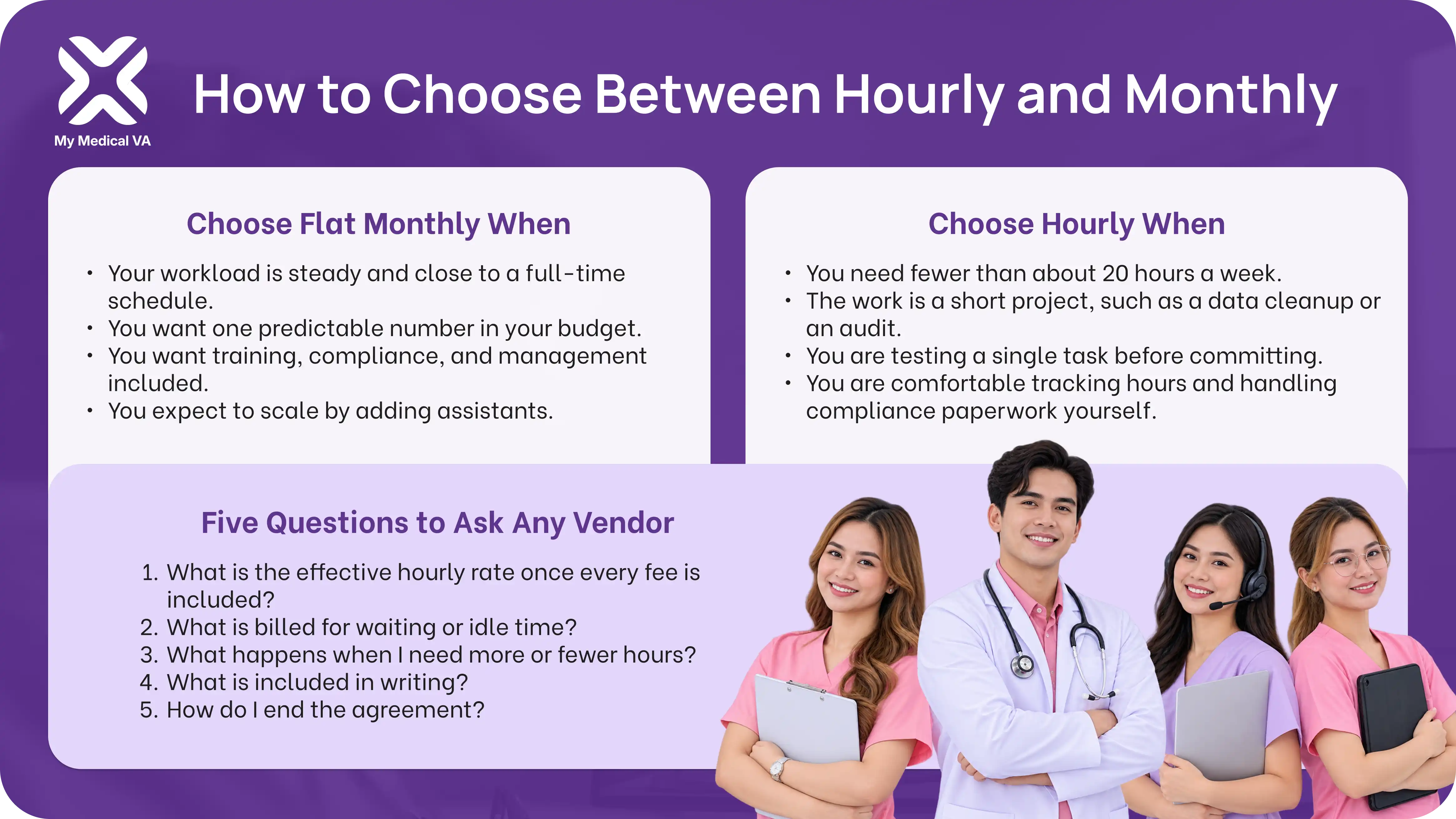
Choose Flat Monthly When
- Your workload is steady and close to a full-time schedule.
- You want one predictable number in your budget.
- You want training, compliance, and management included.
- You expect to scale by adding assistants.
Choose Hourly When
- You need fewer than about 20 hours a week.
- The work is a short project, such as a data cleanup or an audit.
- You are testing a single task before committing.
- You are comfortable tracking hours and handling compliance paperwork yourself.
Five Questions to Ask Any Vendor
- What is the effective hourly rate once every fee is included?
- What is billed for waiting or idle time?
- What happens when I need more or fewer hours?
- What is included in writing?
- How do I end the agreement?
Between 20 and 30 hours a week, price it both ways using Example 2. The answer is in the fees.
My Medical VA Pricing: Flat Monthly, Starting at $9/Hour
My Medical VA charges a flat monthly rate that starts at $9/hour. Placements are full-time and dedicated, with HIPAA training, the BAA, and account management included. A matched candidate is presented within 48 hours of your consultation, and onboarding takes 3 to 5 days.

There is no long-term contract. To add capacity, add an assistant. To scale back, reduce, with no penalty.
Rates depend on the role and experience level you need. See the pricing page for current options, or read the cost guide for the factors that drive price across every model.
Ready to Compare Hourly and Monthly Pricing for Your Practice?
Medical VA hourly vs monthly pricing is easiest to settle with your own numbers. List the hours you need each week, add every fee in each quote, and divide by hours worked.
If the work is steady and near full time, the flat monthly rate will usually win. If it is a few hours a week, hourly will.
The fastest way to run your numbers is a short conversation about your weekly hours, your EMR, and the tasks you want to hand off.
Your Guide To Common Questions & Solutions
Which costs less: medical VA hourly vs monthly pricing?
It depends on your hours. At the same rate, hourly billing costs less below full-time hours, and a flat monthly rate costs less per productive hour once the work is steady and fees are counted. Compare effective hourly cost: total cost including every fee, divided by hours worked.
What does the flat monthly rate include?
At My Medical VA, the flat monthly rate includes a full-time dedicated assistant, annual HIPAA training, a signed BAA, a background check, EMR matching, a dedicated account manager, HR and payroll management, and a replacement guarantee. No benefits, payroll taxes, or office costs are added on top.
Does My Medical VA offer hourly billing or part-time placements?
My Medical VA placements are full-time and dedicated, priced as a flat monthly rate that starts at $9/hour. If you need far fewer hours, say so in your consultation so you can confirm what fits your workload.
How do I compare two virtual assistant quotes?
Multiply each hourly rate by the hours you will use, add every setup, management, and minimum-hour fee, subtract anything the vendor includes that you would otherwise pay for, and divide by hours worked. The lowest effective hourly rate is the cheaper quote.
How does a flat monthly rate compare with an in-house hire?
My Medical VA's average cost savings vs in-house staffing is 70%, with no benefits, payroll taxes, or office costs added to the rate. Savings vary by practice. The pricing page has the full side-by-side comparison.
Is there a long-term contract?
No. My Medical VA operates on a flat monthly rate with no long-term contract, so practices scale up or down with patient volume without penalty.