Dental Billing Virtual Assistant: Cost, ROI, and When to Hire
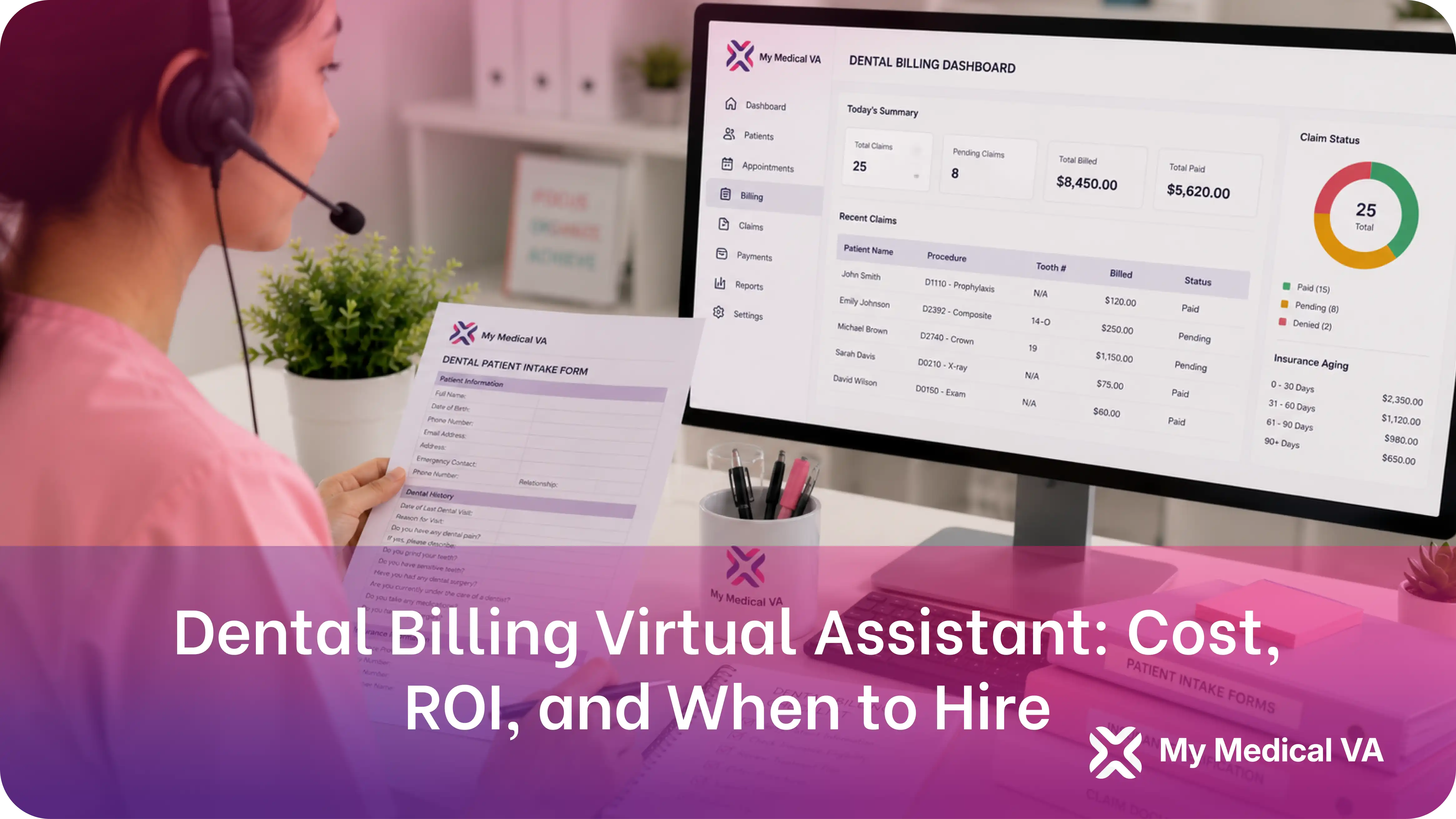

Most dental practices do not have a billing problem. They have a billing bandwidth problem.
The work itself is doable: submit clean claims, verify benefits before the patient sits down, post payments, follow up on aging accounts, and work on the denials. The issue is that the same front-office person handling all of that is also greeting patients, answering phones, processing payments, scheduling, and putting out a steady stream of small fires. Something has to give, and usually it is the back-end revenue work because no one is sitting in the lobby waiting for it.
That gap is what a dental virtual assistant for billing fills. This guide covers what they actually do, what they cost, where the ROI comes from, and how to decide whether your practice is ready to bring one on.
What a Dental Billing Virtual Assistant Actually Does
A dental billing virtual assistant is a remote professional who manages a dental practice's revenue-cycle operations. Core responsibilities include insurance verification, claim submission, denial management, payment posting, accounts receivable (AR) follow-up, and patient billing communication.
The day-to-day is more granular than the job description suggests. A typical morning for a dental billing VA might include:
- Verifying insurance for tomorrow's patients: eligibility, coverage breakdowns, frequency limitations, and how much of the deductible is already met
- Submitting yesterday's completed procedures as claims, with proper (Current Dental Terminology) CDT coding and any required narratives or X-ray attachments
- Working a queue of claims aged 31 to 60 days, calling carriers and escalating where needed
- Posting EOBs received that morning and flagging underpayments against the fee schedule
- Sending patient statements and follow-up messages for outstanding balances
- Surfacing recurring denial patterns to the office manager
This is not "we will help with billing." It is the same work an in-house biller does: performed remotely, integrated into your practice management software, and reporting to your office manager or doctor on a defined cadence.
The Dental Claims Lifecycle (and Where It Breaks)
Every dental claim moves through roughly the same six stages. Most revenue leaks happen at the same handful of points.
- Pre-treatment verification — confirming coverage, deductible status, frequency limitations, and downgrade rules before the appointment.
- Charge entry and coding — selecting the correct CDT codes, such as D1110 for adult prophy, D2740 for crowns, or D7140 for simple extractions, and attaching the required documentation.
- Claim submission — sending the claim through the clearinghouse, usually within 24 to 48 hours of treatment.
- Adjudication — the carrier approves, denies, or requests more information.
- Payment posting and adjustment — applying the insurance payment, write-offs, and patient responsibility to the ledger.
- AR follow-up — chasing what has not been paid and resolving denials.
2740 Consulting's 2025 industry review and Intake Dental's 2026 analysis put dental claim denials at roughly 15 to 20 percent on first submission, up from around 11 percent a few years ago. The breakdown points are predictable: missing or outdated patient information, frequency conflicts (billing a D1110 inside a six-month window from the prior cleaning), missing pre-authorization for major work, inaccurate CDT codes, and coordination-of-benefits issues for patients with secondary insurance.
A billing VA's job is not just to push claims out faster. It is to prevent the denials that drain hours of rework later.
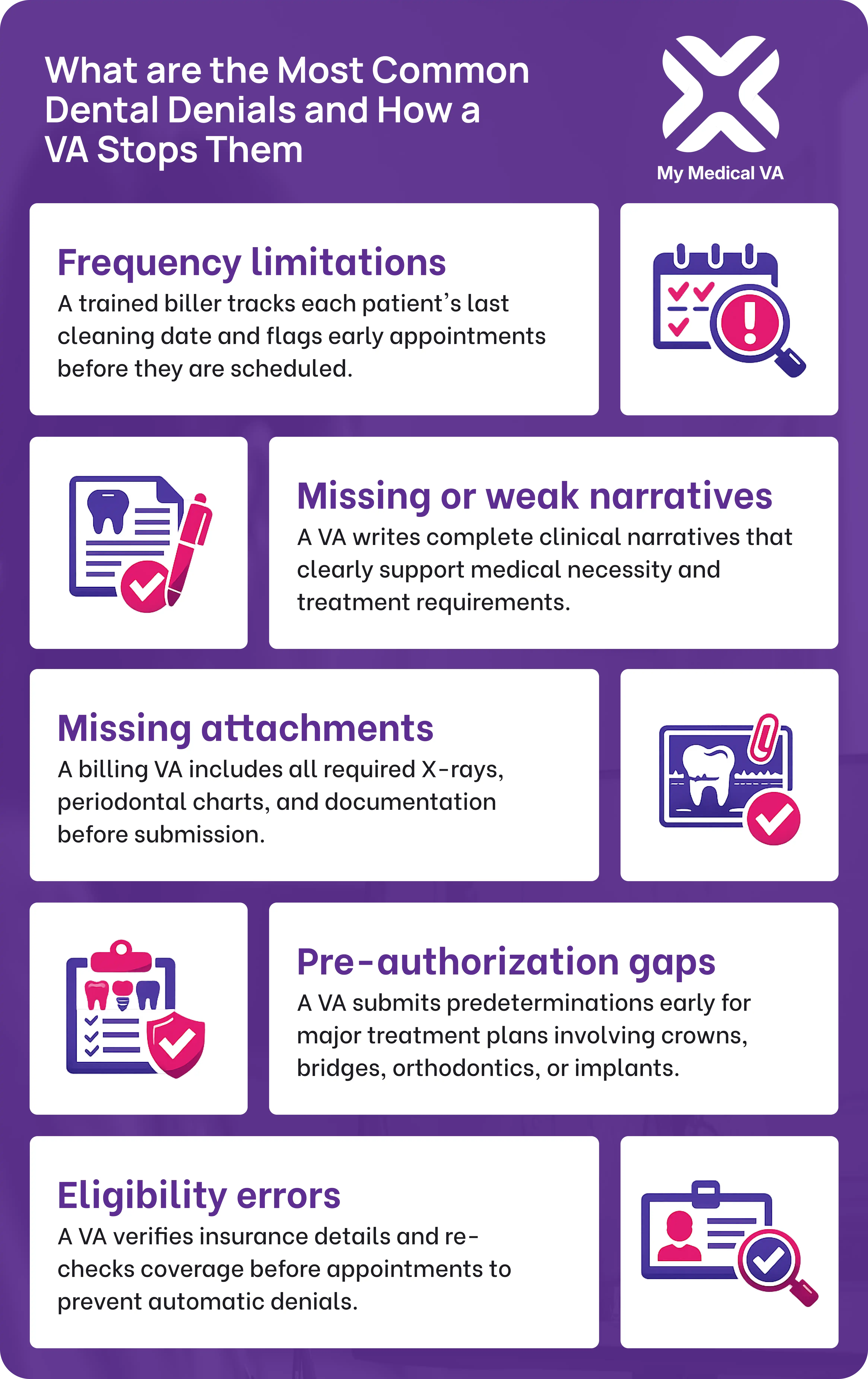
What are the Most Common Dental Denials and How a VA Stops Them
Five (5) denial categories show up over and over in dental billing.
Frequency limitations
Most plans allow a prophylaxis twice per benefit year, often six months apart from the date of service, not the calendar year. A claim submitted a week early gets denied automatically. A trained biller tracks each patient's last cleaning date and flags the scheduler before the appointment is even set.
Missing or weak narratives
Major restorative procedures such as D2740 crowns, D2950 core buildups, and D4341 scaling and root planing per quadrant typically require a clinical narrative justifying medical necessity. "Tooth #14 had decay" does not cut it. A narrative that references the tooth number, specific clinical findings, prior treatment history, and the failed conservative alternatives gets paid. A VA who understands what carriers want writes the narrative correctly the first time.
Missing attachments
A D7140 extraction claim without a pre-op X-ray, or a scaling-and-root-planing claim without periodontal charting showing 4mm+ pockets and current radiographs, will be denied or pended. A billing VA includes the attachments before submission.
Pre-authorization gaps
Major work increasingly requires pre-authorization. Industry reporting from Intake Dental in 2026 attributes roughly 30 percent of dental payment delays to lengthy pre-approval processes. A VA gets ahead of these by submitting predeterminations on treatment plans involving crowns, bridges, orthodontics, or implants.
Eligibility errors
Outdated insurance, wrong member ID, missing secondary coverage. Intake Dental's 2026 industry analysis reports that real-time insurance verification is a challenge for roughly 71 percent of dental practices. A VA who owns this step and re-verifies the day before the appointment prevents the most common cause of automatic denial.
How a Dental Billing Virtual Assistant Handles Insurance Verification
Verification is not a checkbox. Done well, it includes:
- Confirming active coverage and effective dates
- Verifying the deductible and how much has been met
- Identifying annual maximums and how much has been used
- Listing covered procedures and frequency limitations
- Noting downgrades (for example, posterior composite paid at the amalgam rate)
- Flagging waiting periods on major work
- Confirming in-network status and the applicable fee schedule
- Coordinating primary and secondary coverage
- Capturing pre-authorization requirements
A practice that does this 24 to 48 hours before the appointment, instead of when the patient walks in, eliminates a whole category of bad surprises. Patients arrive knowing their share, treatment plans get accepted more often, and the claim that follows has every box checked.
The AR Aging Playbook
Aging accounts receivable is where dental billing goes to die. Most practices have a healthy zero-to-30-day bucket and a graveyard at 90+ days. A billing VA works the buckets like this:
0 to 30 days
Claims monitored daily for clearinghouse rejections (these are formatting issues caught before the carrier even sees the claim, distinct from denials). Rejections fixed and resubmitted same-day.
31 to 60 days
Outstanding claims worked weekly. Calls placed to carriers on anything pending. Patient balances move into the statement cycle.
61 to 90 days
Active denial management. Each denial gets categorized whether that’s eligibility, frequency, documentation, or coding and routed to the appropriate fix path. Appeals filed where the denial is incorrect.
90+ days
Triage. Some balances move to collections, some get written off, some get patient-facing payment plans. A trained VA does not let this bucket sit — it is where revenue quietly disappears.
The goal is not a perfect zero AR. It is a clean, predictable AR where the majority of dollars sit in the 0-to-30 bucket and nothing falls through the cracks.
HIPAA Compliance When Hiring a Dental Billing Virtual Assistant
Dental billing touches some of the most sensitive PHI in a practice: insurance details, payment information, treatment histories, X-rays, and clinical notes. A virtual assistant handling this data needs to operate inside the same compliance perimeter as in-house staff.
That means HIPAA training (and documented re-training), a Business Associate Agreement between the practice and the VA's employer, secure communication channels (no plain email for PHI), role-based access controls inside the practice management software, encrypted devices, and physical security where the VA works. Practices that take HIPAA seriously vet these things specifically, not as a checkbox, but as a condition of access.
The risk is not theoretical. HIPAA violations can carry per-record fines, and dental practices have been subject to enforcement actions for far less.
What It Actually Costs You
In-house dental billers in the United States earn between roughly $44,000 and $61,000 per year on average, according to 2025 and 2026 salary data from ZipRecruiter and Glassdoor, with experienced specialists in higher-cost metros earning $70,000 or more. Layer on payroll taxes, benefits, paid time off, and onboarding costs, and the fully loaded cost of an in-house biller typically runs 25 to 30 percent higher than the base salary.
Dental billing virtual assistants are usually engaged on an hourly model. Rates for trained, HIPAA-compliant dental billing professionals serving the US market generally start around $11 per hour, with no employer-side benefits, payroll taxes, or office overhead. A full-time VA at 40 hours per week works out to roughly $1,900 per month, or about $23,000 per year.
The honest math: for most markets, the fully loaded cost of one in-house biller covers two full-time billing VAs, and in higher-cost metros the gap is even wider.
Recovered revenue from worked AR
If your practice has $30,000 sitting in 60+ day buckets and a VA recovers even 40 percent of it over three months, that is $12,000 of cash that would not have come in otherwise.
Reduced denials
A 5-percentage-point drop in first-pass denial rate on a practice doing $1.2M annually in insured production is roughly $60,000 in claims that get paid the first time instead of needing rework and a meaningful share of those denials, left unworked, would never have been resubmitted at all.
Freed front-office capacity
Every hour your front-desk team spends on billing is an hour they are not spending on case acceptance, recall calls, or the patient in front of them. The opportunity cost is real even if it is harder to put a number on.
When to Hire and When to Wait
Signs a dental billing VA will pay off:
- Your AR over 60 days is more than 15 to 20 percent of total AR
- Your front desk regularly works through lunch or stays late on billing
- Your denial rate is climbing or unknown
- You have not sent patient statements in more than 30 days
- Treatment plans get accepted but do not get scheduled because no one has time to follow up
- You are losing in-house billing staff to retirement or turnover. The 2025 Dental Industry Salary Report from DentalPost (conducted with Dental Economics) found 28 percent of front-office associates planning to apply for new jobs in 2025, while a separate DentalPost 2024 survey found that 32 percent of dental billing specialists plan to retire within six years
Signs to wait or fix something else first:
- Your fee schedule has not been updated in years (a VA cannot fix structural underpricing)
- CDT coding habits are inconsistent at the provider level
- Your practice management software is configured incorrectly (a VA inherits bad data)
- You do not have an office manager or owner who can supervise and give feedback
Comparing Your Options: Dental Billing Virtual Assistant vs. In-House vs. Outsourced Service
A dental billing virtual assistant is one of three common options. The comparison below shows where each fits.
The right fit depends on practice size, billing complexity, and how much management bandwidth is available to supervise the role.
How to Hire a Dental Billing VA Well
Most practices hire dental billing VAs through a staffing provider rather than directly. A few questions that separate strong dental VA providers from generic agencies:
- How do you train and screen your dental billing VAs specifically, and what does the certification process look like?
- Which dental practice management systems do your billing VAs work in regularly? (Dentrix, Open Dental, Eaglesoft, Curve, Denticon)
- Will you sign a Business Associate Agreement, and what does your HIPAA program include?
- What's your replacement process if my VA leaves, gets sick, or needs extended time off?
- What does onboarding look like, and what should I expect in the first 30 days?
- Can you connect me with two or three US dental practices currently using your billing VAs?
If a provider hedges on these, look elsewhere. If they answer with specifics — named training programs, real PMS systems, a signed BAA, and dental practice references — you have a real partner.
Ready to Add a Dental Billing Virtual Assistant to Your Team?
If you've read this far, you already know the case: dental claim denials are climbing, billing and front-office staff are harder to hire and keep, and the work doesn't slow down for either. A trained dental billing VA closes that gap without the cost or hiring friction of an in-house seat.
MyMedicalVA places HIPAA-trained dental virtual assistants, including billing specialists, starting at $11 per hour. Every VA is screened for US dental experience and trained on the major practice management systems. We supervise throughout the engagement, not just at placement.
Your Guide To Common Questions & Solutions
Are dental billing virtual assistants HIPAA-compliant?
Reputable providers train their VAs to HIPAA standards, sign Business Associate Agreements, use secure communication channels, and operate inside role-based access controls within the practice management software.
How long does it take a dental billing virtual assistant to get up to speed?
Most practices see meaningful contribution within two to four weeks. The first week is shadowing and software familiarization, weeks two and three are supervised production, and by week four the VA is typically working independently with weekly check-ins.
Can a dental billing virtual assistant replace an in-house biller?
Sometimes yes, sometimes a hybrid is better, where the VA handles claims, AR, and verification, while in-house staff stays focused on in-person patient financial conversations.
The right structure depends on the practice's volume and team dynamics.
Where are dental billing virtual assistants typically based?
Most US-facing dental billing VAs work from the Philippines, Latin America, or other regions with strong English fluency and overlapping time zones. The best providers vet for US dental billing experience specifically, not just general healthcare or generic billing.