Bilingual Medical VA: Why It Matters for Your Patients

A bilingual medical VA is not just an assistant who happens to speak two languages. It is a specific skill set: live call translation, bilingual documentation, and the ability to build trust with a patient who is more comfortable receiving care in their first language.
For US practices with a meaningful Spanish-speaking patient base, this is not a nice-to-have.
KEY TAKEAWAYS
- Bilingual in a virtual assistant context ranges from conversational to fully fluent, and the difference matters more than most practices realize before hiring.
- The real hesitation is not whether bilingual support helps patients. It is whether a bilingual assistant is as capable at the admin work itself.
- A properly matched bilingual medical VA does not trade administrative skill for language ability. Both are verified before placement.
- My Medical VA sources from Latin America as well as the Philippines, which is why native Spanish fluency is available here in a way it is not with Philippines-only staffing models.
What "Bilingual" Actually Means in a Virtual Assistant Context
The word gets used loosely. Not every assistant labeled bilingual can do the same things, and the differences matter for how you use them.
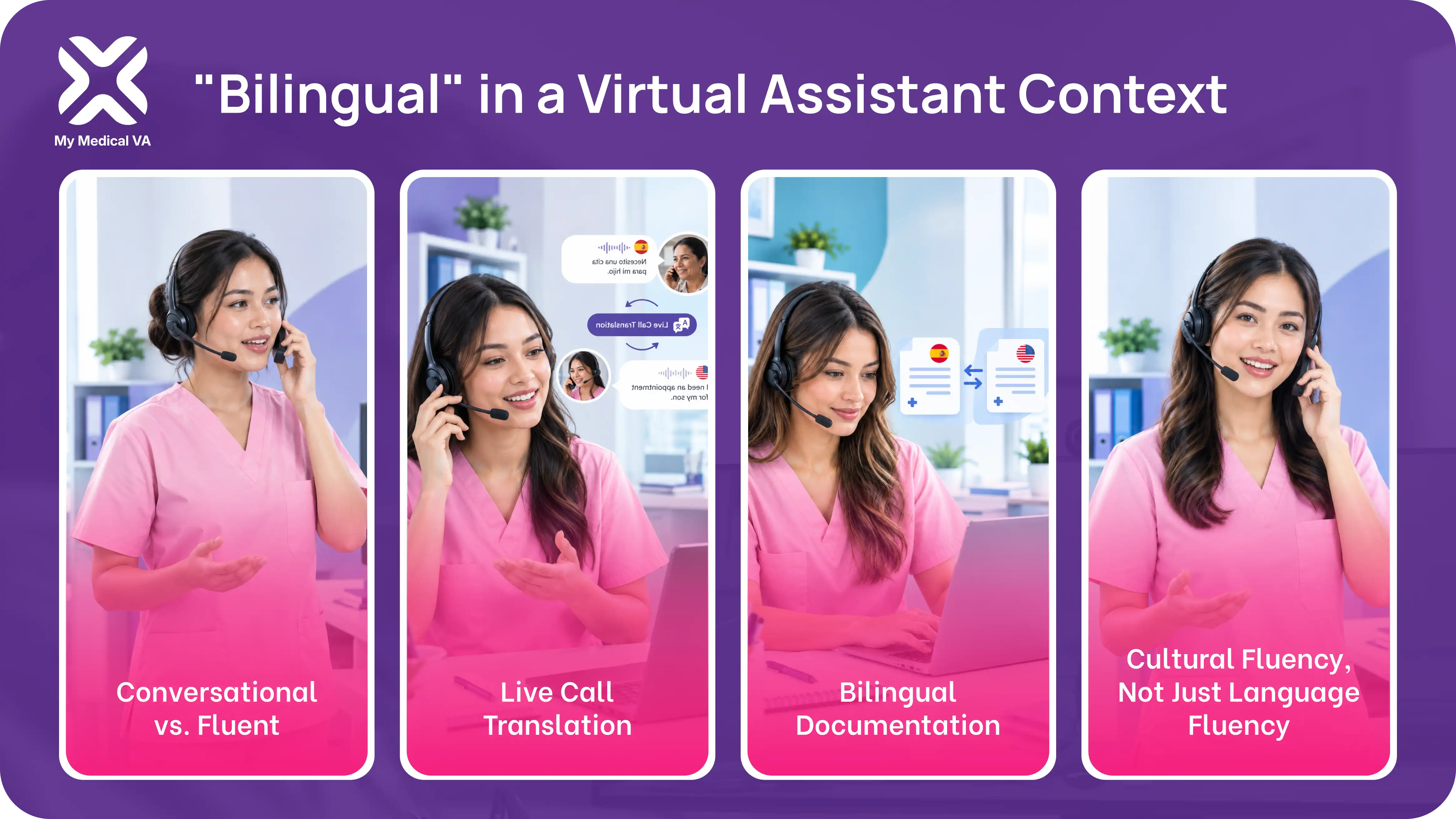
Conversational vs. Fluent
Conversational Spanish covers basic patient interactions, scheduling, simple questions, general reassurance. Fluent Spanish handles a live call where a patient needs to explain symptoms, insurance concerns, or a billing dispute in detail, without the assistant translating in their head sentence by sentence.
If your patient population needs the second kind of conversation, confirm fluency specifically, not just that the assistant is labeled bilingual.
Live Call Translation
Some bilingual assistants can translate in real time during a three-way call between the practice, the patient, and a provider.
This is a distinct skill from simply speaking the language, it requires holding two conversations in parallel without losing accuracy in either one.
Bilingual Documentation
Separate from spoken fluency, bilingual documentation means the assistant can accurately translate intake forms, consent language, and patient instructions into Spanish without losing clinical precision.
A patient who speaks Spanish well enough for a phone call may still need documentation in their first language to fully understand what they are signing. Consent forms in particular carry legal weight, and a loose or approximate translation can create real liability if a patient later disputes what they understood themselves to be agreeing to.
Cultural Fluency, Not Just Language Fluency
Language ability alone does not guarantee comfort. A patient may respond differently to a direct question about payment or a sensitive health topic depending on cultural context, not just the language it is asked in.
An assistant with strong cultural fluency, not just vocabulary, navigates these moments with more care, which shows up in patient satisfaction even when the administrative outcome is identical either way.
Is a Bilingual Medical Virtual Assistant as Skilled at the Admin Work?
This is the real hesitation, and it deserves a direct answer rather than a reassurance.
The concern is reasonable. If a staffing model treats bilingual candidates as a separate, lower bar, screened for language but not administrative skill, the concern is justified. That is not how a properly matched placement works.
A bilingual medical VA should be evaluated against the same administrative criteria as any other candidate: HIPAA training, EMR experience, billing and insurance verification skill, and specialty-specific workflow knowledge.
Bilingual ability is an addition to that skill set, not a substitute for it. If a staffing provider cannot verify both independently, that is the actual red flag, not the fact that the candidate is bilingual.
Why Patients Notice the Difference
A patient who is more comfortable in Spanish than English is not just more comfortable, they are also more likely to fully understand their coverage, their instructions, and their financial responsibility when those are communicated in their first language.
Miscommunication at intake or during a billing conversation creates downstream problems: missed appointments, confusion about what is owed, or incomplete understanding of a treatment plan.
A bilingual medical VA reduces this friction directly, at the exact points, intake, scheduling, and billing conversations, where miscommunication is most likely to cause a real problem later.
Consider a common scenario: a patient calls to reschedule and mentions in passing that they are confused about a bill they received. An English-only front desk can reschedule the appointment but may not be able to fully resolve the billing confusion at the moment, leading to a second call, a delayed payment, or a frustrated patient.
A bilingual assistant can handle both in the same conversation, in the language the patient is actually comfortable using, which is often the difference between a resolved issue and an open one.
What a Bilingual Medical VA Handles
The task list does not change from a standard Medical Admin Assistant role. What changes is the language capability layered on top of it.
Bilingual Patient Intake
Collecting demographics, insurance information, and consent in whichever language the patient is most comfortable using, without losing accuracy in the process.
Bilingual Scheduling and Reminders
Handling appointment scheduling, confirmations, and reminder calls in Spanish for patients who prefer it, reducing no-shows tied to miscommunication rather than genuine unavailability.
Bilingual Insurance and Billing Conversations
Explaining coverage, copays, and billing questions in the patient's first language, which is often where the most confusion and frustration happens in a monolingual practice.
Bilingual Documentation Review
Reviewing and translating patient-facing forms and instructions so a Spanish-speaking patient receives the same clarity an English-speaking patient gets by default.
Why LATAM Sourcing Makes a Bilingual Medical VA Possible
Many virtual medical assistant companies source primarily from the Philippines. That model produces excellent English-language administrative talent, but it does not reliably produce native Spanish fluency, since Spanish is not a primary language in that talent pool.
My Medical VA sources from Latin America as well as the Philippines. That means candidates who are native Spanish speakers and trained medical administrative professionals, not English-speaking staff who picked up conversational Spanish as a secondary skill.
This is the structural reason a bilingual medical VA is available here in a way it often is not with a Philippines-only staffing model.
This distinction shows up in practice, not just in a candidate's resume. A native speaker handling a live call brings natural cadence, regional phrasing, and cultural context that a second-language speaker, however capable, has to work harder to produce.
For a patient already anxious about a health concern or a bill, that difference is often the line between a conversation that feels natural and one that feels effortful for both sides.
Measuring Whether Bilingual Support Is Actually Working
A practice that adds bilingual support should expect to see it in specific, trackable outcomes: fewer missed appointments among Spanish-speaking patients, fewer repeat calls to resolve a single billing question, and fewer instances of a patient signing a form without fully understanding it.
If none of these improve after adding bilingual support, that is a signal the placement was not matched correctly, not that bilingual support itself does not work.
What to Confirm Before Hiring
Ask directly whether the candidate is conversational or fluent, whether they can handle live call translation or only bilingual documentation, and whether their administrative skills were verified independently of their language ability.
Request a short sample interaction if possible, a mock scheduling call or a review of translated intake language, rather than relying on a self-reported fluency level.
Confirm whether the assistant has handled bilingual documentation for consent forms specifically, since consent language carries legal weight and requires more precision than casual conversation. A staffing provider who can answer all of this clearly is one who has actually built bilingual capability into their model, not bolted it on as an afterthought.
Finding the Right Bilingual Fit for Your Practice
A bilingual medical VA gives Spanish-speaking patients the same clarity and comfort English-speaking patients get by default, without sacrificing the administrative skill your practice depends on.

The practices that get the most value from bilingual support are the ones that treat it as a specific skill to verify, fluency level, live call translation, documentation accuracy, rather than a checkbox on a candidate profile.
My Medical VA verifies both independently, sourcing native Spanish fluency from Latin America rather than treating bilingual ability as a secondary skill layered onto an English-first candidate pool. If the hesitation holding you back is whether a bilingual assistant can really do both, that is exactly the question a direct conversation can answer.
Your Guide To Common Questions & Solutions
What does bilingual mean for a medical virtual assistant?
Bilingual can mean anything from conversational Spanish for basic patient interactions to full fluency capable of live call translation and bilingual documentation. Confirm which level a candidate offers before assuming it matches your patient population's needs.
Does a bilingual medical VA cost more?
My Medical VA places bilingual medical admin assistants starting at $9/hour, the same flat monthly rate structure as a standard placement, with HIPAA training, the BAA, and account management included.
Is a bilingual assistant as skilled at admin work as an English-only assistant?
Yes, when properly matched.
Bilingual ability should be verified in addition to standard administrative criteria, HIPAA training, EMR experience, billing skill, not as a substitute for them. A staffing provider that cannot verify both independently is not offering a properly matched placement.
Why can't every virtual assistant company offer native Spanish fluency?
Many virtual medical assistant companies source primarily from the Philippines, which produces strong English-language talent but not reliably native Spanish fluency.
My Medical VA sources from Latin America as well, which is where native Spanish-speaking administrative talent is more readily available.
How quickly can a practice get matched with a bilingual assistant?
Most practices are matched within 48 hours of the initial consultation, with onboarding completing in 3 to 5 days, the same timeline as any other placement.