HIPAA Compliant Virtual Assistant Guide: What to Know


This HIPAA compliant virtual assistant guide covers what the compliance standard actually requires for any remote staff member handling patient data in a medical practice. For small medical practices and solo physicians, this means understanding what safeguards must be in place, what a HIPAA compliant virtual assistant does, and what to verify before you bring remote admin support into your workflow.
KEY TAKEAWAYS
- A HIPAA compliant virtual assistant must complete annual HIPAA training, sign a Business Associate Agreement, and operate under documented security protocols before accessing any patient record.
- HIPAA training alone is not sufficient. Compliance requires role-based access controls, encrypted communication, multi-factor authentication, and monitored workstations operating together.
- A Business Associate Agreement is a legal requirement under HIPAA whenever a remote worker accesses, stores, or transmits protected health information on behalf of your practice.
- Before hiring, verify training records, BAA status, background check completion, and security protocol documentation from any VA company in writing.
What Makes a Virtual Assistant HIPAA Compliant?
HIPAA compliance for a virtual assistant is not a single certification or a one-time training course.
It is a set of operational requirements that must be fully in place before a remote worker ever opens a patient record, processes an insurance claim, or enters a demographic into your EMR. As a practice owner, you are responsible for verifying those requirements are met. Do not rely on a verbal assurance that protocols are in place.
Under HIPAA, three categories of safeguards apply to anyone handling protected health information:
Administrative Safeguards
Administrative safeguards cover documented policies on how patient data is accessed, who is permitted to access it, how incidents are reported, and what happens if a breach occurs. This includes signed confidentiality agreements and a completed Business Associate Agreement between your practice and the placement company. These are not optional paperwork items. They are what protect your practice if something goes wrong.
Technical Safeguards
Technical safeguards cover encrypted communication tools, secure login credentials, multi-factor authentication, and access limited to the specific systems and records the VA needs for their assigned tasks. A VA accessing your EMR over a shared home network or a personal device does not meet this standard, regardless of how qualified they are.
Physical Safeguards
Physical safeguards cover a dedicated, monitored workspace with a secure, private internet connection. Working in a shared or public environment where patient information could be overheard or observed creates healthcare data security risk regardless of how the data is transmitted.
All three categories must be satisfied simultaneously. A training certificate does not offset unsecured access. A signed BAA does not compensate for unencrypted communication. The standard requires all components in place, not a selection of them.
What Does a HIPAA Compliant Virtual Assistant Do?
The role is administrative and billing-focused.
A HIPAA compliant virtual assistant handles the tasks that require accessing, entering, or transmitting patient information, always working inside HIPAA-compliant workflows and under your direction. For solo doctors and small practices, this is the same work currently handled by in-office staff, performed remotely by dedicated, trained support.
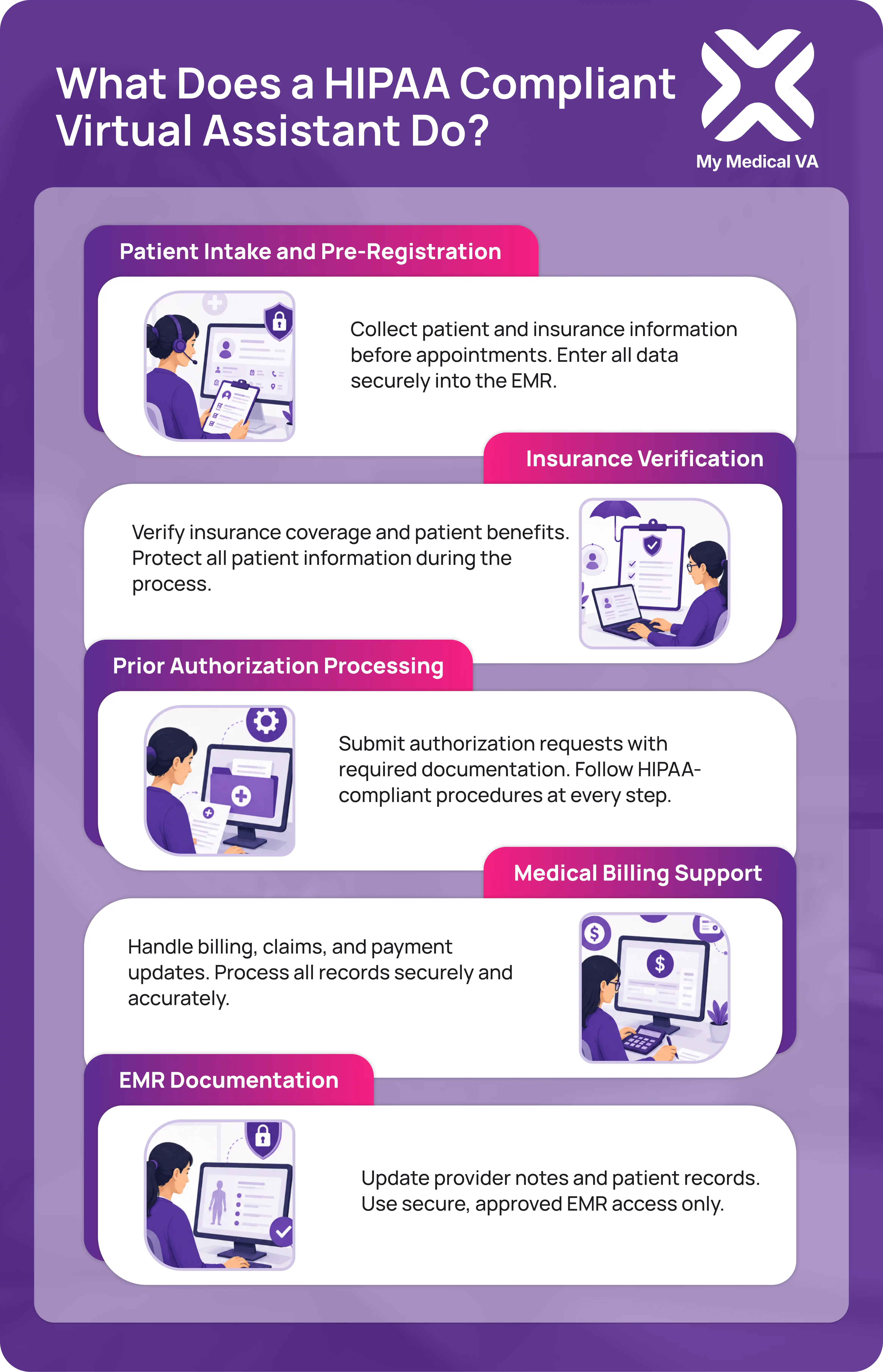
Patient Intake and Pre-Registration
Collecting demographic information, insurance coverage details, and consent documentation before each appointment. Every field entered into your EMR involves protected health information, which is why this task requires a HIPAA-trained staff member, not a general virtual assistant.
Insurance Verification
Confirming active coverage, benefits, and patient financial responsibility through payer portals. Accessing a patient's insurance record means accessing identity and plan data that qualifies as PHI under HIPAA.
Prior Authorization Processing
Submitting clinical documentation to payers on behalf of your providers. Auth submissions contain diagnosis codes, procedure details, and patient history. All of this is PHI handled under documented protocols.
Medical Billing Support
Charge entry, payment posting, claim scrubbing, and AR follow-up. Every step in the billing cycle involves patient and payer data covered by HIPAA.
EMR Documentation
Entering provider-directed clinical notes, referral documentation, and post-visit chart completion directly into your system. Remote EMR access requires role-based permissions, MFA, and a signed BAA in place before it begins.
None of these tasks can be assigned to a general virtual assistant or an unvetted remote worker without creating real risk for your practice. The compliance burden does not disappear because the arrangement is informal.
HIPAA Requirements a Virtual Assistant Must Meet Before Day One
Before any remote healthcare staff member accesses your practice's data, verify these specific requirements are in place:
Annual HIPAA Training Completed
Training through an accredited program covering the Privacy Rule, Security Rule, and PHI handling protocols. Training records should be documented and available on request. Annual re-training is required, not a one-time completion.
Business Associate Agreement Signed
A BAA is a legal contract between your practice and any third party who accesses PHI on your behalf. If you are working with a VA placement company, the BAA should be between your practice and that company, with a separate confidentiality agreement signed by the individual VA assigned to you.
Role-Based Access Controls in Place
The VA should have access only to the systems and records required for their specific assigned tasks. Broad EMR access without task-level restrictions is a healthcare data security risk.
Multi-Factor Authentication Enabled
All EMR and portal access requires MFA. A username and password alone does not satisfy the technical safeguard requirement for remote access under HIPAA.
Encrypted Communication Confirmed
Any tool used to share patient information (email, messaging platforms, file transfers) must use encryption. Standard personal email accounts and consumer messaging apps do not meet the HIPAA standard.
Activity Logging Maintained
Your EMR and connected systems should log all access and actions. This creates the audit trail HIPAA requires in the event of an investigation.
Documented Incident-Response Protocol
The placement company should have a clear, written process for identifying, reporting, and responding to potential PHI breaches. Ask to review it before placement begins. Not after the VA has already started.
Why the BAA Is Non-Negotiable
The Business Associate Agreement is a legal requirement under HIPAA. It is not a best practice or an optional formality.
Any person or organization that creates, receives, maintains, or transmits protected health information on behalf of a covered entity is classified as a business associate under federal law. A remote VA who enters patient data into your EMR qualifies, regardless of how informal or short-term the arrangement is.
Without a signed BAA, your practice is exposed if a breach occurs. In the event of a complaint or an Office for Civil Rights review, the absence of a BAA is a serious liability that stays with your practice, not the VA company.
When evaluating any HIPAA compliant virtual assistant service, confirm the following before engagement begins:
The placement company has a BAA template ready and signs before the VA's first day. The individual VA has signed a separate confidentiality agreement. Your practice retains signed copies of both documents. The BAA covers the specific tasks the VA will perform in your practice.
If a VA company hesitates about providing a BAA or delays signing until after placement has begun, treat that as a disqualifying signal.
HIPAA Compliant Virtual Assistants vs. General Virtual Assistants
Not every virtual assistant is appropriate for healthcare work.
The difference in compliance requirements is significant. Using a general VA for tasks that involve PHI creates liability for your practice regardless of how well-intentioned the arrangement is. HIPAA does not make exceptions for informal working relationships.
What to Ask a VA Company Before You Hire
Use these questions to verify compliance before signing any placement agreement:
Do Your VAs Complete Annual HIPAA Training?
Ask for documentation of the training program. Confirm that training records for the specific VA assigned to your practice are maintained and available. Self-reported completion is not sufficient.
Do You Provide a BAA?
This should be a direct yes. Ask to review the BAA template before committing to placement. A company that treats this as a formality is a compliance risk.
What Security Protocols Do Your VAs Use?
Look for specific answers: multi-factor authentication, encrypted communication tools, monitored workstations, dedicated private internet connections. Vague answers signal a gap in their actual protocols.
Are Your VAs Background-Checked?
Healthcare admin roles involve access to patient identity data, insurance records, and financial information. Background verification should be completed before placement, not left to your practice to arrange.
What Is Your Incident-Response Protocol?
Even a well-run operation should have a documented process for responding to potential PHI exposures. Ask to review it in writing.
How Do VAs Access Our EMR?
Confirm the access method (VPN, remote desktop, or your EMR's web-based access), who sets the permissions, and who has the authority to revoke access if the relationship ends.
A credible HIPAA compliant virtual assistant company answers all six questions immediately, in writing, without hesitation.
How My Medical VA Handles HIPAA Compliance
Every Medical Admin Assistant placed by My Medical VA is HIPAA-trained before deployment.
Compliance is built into every placement for small practices and solo physicians who need admin and billing support without taking on compliance management themselves. The full framework included with every placement:
- 100% HIPAA-Trained Staff: Annual training through an accredited program before placement, re-completed every year.
- BAA Included: Signed before day one. Documentation provided to your practice.
- Signed NDAs and Confidentiality Agreements: Individual agreements with every Medical Admin Assistant placed.
- Role-Based Access Controls: VA access limited to the systems and records required for their assigned tasks only.
- Multi-Factor Authentication: Required for all EMR and system access.
- Encrypted Communication: No unencrypted channels used for patient data. HIPAA-compliant workflows on every task.
- Monitored Workstations: Dedicated, secure work environments with private internet connections.
- Activity Logging: Maintained through your EMR's native audit trail.
- Documented Incident-Response Protocol: Available for review before placement begins.
For a full overview, visit My Medical VA's HIPAA compliance framework.
For a deeper look, read how HIPAA-trained Medical Admin Assistants handle PHI in day-to-day workflows.
Conclusion
This HIPAA compliant virtual assistant guide covers what the compliance standard actually requires, not just what VA companies say on their websites.
For a solo doctor or small clinic owner, the standard is clear: annual HIPAA training, a signed BAA, role-based access, encrypted communication, MFA, monitored workstations, and a documented incident-response protocol. All in place before day one.
My Medical VA, a remote healthcare staffing company, places HIPAA-trained Medical Admin Assistants with every compliance requirement included in every placement. If your practice needs admin and billing support without the compliance risk of an unvetted hire, book a free consultation to get matched within 24 hours.
Your Guide To Common Questions & Solutions
What does "HIPAA compliant" actually mean for a virtual assistant?
It means the VA operates under the administrative, technical, and physical safeguards required by the Health Insurance Portability and Accountability Act for anyone who accesses, transmits, or stores protected health information. At minimum this includes annual HIPAA training, a signed Business Associate Agreement, role-based access controls, encrypted communication, multi-factor authentication, and a monitored workstation.
Is a HIPAA training certificate enough to make a VA compliant?
No. Training is one required component of a compliant setup, but it does not stand alone. Without a BAA, MFA, encrypted communication, and documented access controls, a VA holding a training certificate still creates compliance risk for your practice. All components must be in place simultaneously.
Does a remote VA need a Business Associate Agreement?
Yes. Any individual or organization that handles PHI on behalf of your practice is classified as a business associate under HIPAA. A signed BAA is legally required before that relationship begins. There is no exception for remote or informal arrangements.
What happens if a VA accesses patient data without proper safeguards?
Your practice carries responsibility even if you were unaware the safeguards were insufficient. In the event of an OCR review, the absence of a BAA or documented security protocols is a significant liability factor that does not shift to the VA or the placement company by default.
How do I verify a VA's HIPAA training?
Ask the VA company for documentation of the training program and written confirmation that the specific VA assigned to your practice has completed the current training cycle. Annual re-training should be standard, verifiable, and not self-reported.
Can a HIPAA compliant virtual assistant work in my specific EMR?
It depends on the VA's verified system experience. HIPAA compliance covers how the VA handles patient data. EMR experience covers whether they can work effectively in your specific workflow. Verify both separately when evaluating any placement.